


K12MovieGuides
National Parks Virtual Field Trip Bundle | 13 Audio & Map Exploration Lessons
National Parks Virtual Field Trip Bundle | 13 Audio & Map Exploration Lessons
Couldn't load pickup availability
Classroom Use at a Glance
13 ready-to-use WanderListen National Park virtual field trip lessons for grades 6–12 with 93 mapped stops, about five hours of narrated audio, interactive map and visual exploration, teacher guides, student worksheets, answer keys, and self-grading quizzes.
- Resource type
- Virtual Field Trip Bundle
- Grade band
- Grades 6–8 Grades 9–12
- Rating
- Not Rated
- Time required
- Flexible: 45–90 Minutes per Park
- Prep level
- No Prep
- Subject
- Science Social Studies
- Classroom use
- Sub Plans Whole-Class Instruction Independent Work Homework Discussion Assessment
- Includes
- Teacher Guide Student Worksheet Answer Key Discussion Questions Vocabulary Google Forms Quiz Google Slides/PPTX Printable Quiz Start Here PDF
- Tech format
- PDF Google Slides Google Forms Google Docs PPTX DOCX ZIP
WanderListen National Parks Virtual Field Trip Bundle
Explore 13 major U.S. National Parks through 93 mapped stops and about five hours of narrated, app-style virtual field trips. Each lesson combines audio narration, interactive map exploration, visual evidence, teacher guides, student worksheets, and assessment materials for grades 6–12.
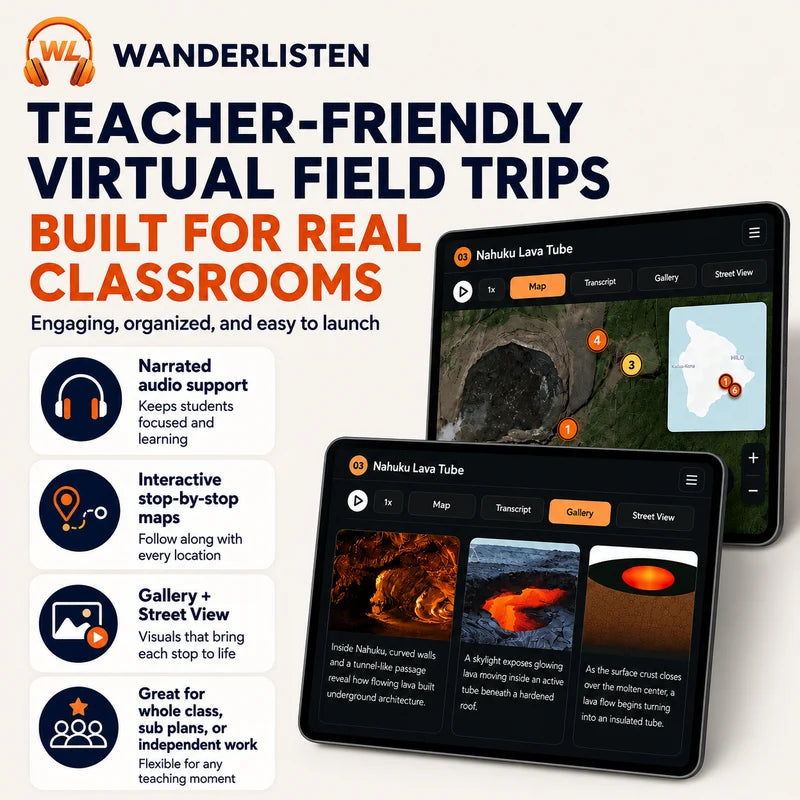
Built around the WanderListen app experience: students listen to focused narration, move through mapped stops, examine gallery evidence, and explore Street View when available. Google Slides, printable worksheets, and quizzes support the experience rather than replacing it.
Use the collection as a National Parks enrichment sequence, rotate parks through Earth science and geography units, or assign individual tours as no-prep lessons, sub plans, independent work, review, or interdisciplinary extensions.
Want to try the format first? Get the complete Grand Canyon National Park Virtual Field Trip 100% FREE.
Grand Canyon is free individually and is also included here so the full 13-park sequence stays together in one collection.
What students practice
- Earth systems: compare volcanoes, glaciers, rivers, canyons, coasts, wetlands, mountains, forests, fire, weather, and watersheds across very different park landscapes.
- Map and visual evidence: use mapped stops, panoramas, photographs, diagrams, gallery evidence, and Street View to connect visible landforms to geologic and ecological processes.
- Cause and effect: explain how water, ice, heat, erosion, elevation, climate, fire, and human decisions reshape landscapes over time.
- Ecology and environmental management: examine habitats, biodiversity, restoration, hazards, visitor infrastructure, resource management, and changing environmental conditions.
- Cultural landscapes and public lands: study Indigenous history and continuing relationships, park creation, stewardship, engineering, and the consequences of management choices.
- Evidence-based responses: use teacher-ready worksheets, discussion prompts, vocabulary, End of Tour questions, and quizzes for short writing, discussion, and assessment.
What's included
- 13 complete WanderListen National Park virtual field trip lessons — 12 paid park lessons plus the complete Grand Canyon lesson, which is also available free individually.
- 93 mapped tour stops in total.
- About 4 hours 46 minutes to 5 hours of total narrated tour audio across the collection.
- App-style map exploration with stop-level images, galleries, and Street View where available.
- Teacher Guides with implementation notes and answer keys.
- Student worksheets with stop observation questions.
- Vocabulary, discussion questions, and End of Tour questions.
- Self-grading Google Forms quizzes plus printable multiple-choice quiz options.
- Google Slides/PPTX and print/digital classroom materials.
- Individual tour access/setup materials for every included park.
The 13 National Park Virtual Field Trips
-
Yellowstone National Park
Hydrothermal systems, geysers, canyon landscapes, wildlife, and public-land science. -
Grand Canyon National Park — FREE individually
Rock layers, deep time, the Colorado River, erosion, cultural connections, and public-land stewardship. -
Hawaiʻi Volcanoes National Park
Active volcanism, lava-built landscapes, ecological change, and Native Hawaiian cultural connections. -
Yosemite National Park
Granite, glaciation, waterfalls, watersheds, giant sequoias, fire ecology, and Indigenous history. -
Everglades National Park
Wetland water flow, habitats, wildlife, engineered water systems, adaptation, and restoration. -
Great Smoky Mountains National Park
Appalachian ecology, elevation, biodiversity, air and water systems, cultural landscapes, and park history. -
Zion National Park
Sandstone, uplift, river erosion, canyon processes, water, ecosystems, and human relationships with the landscape. -
Rocky Mountain National Park
Glacial landforms, elevation zones, the Continental Divide, watersheds, wildlife, cultural landscapes, and management. -
Olympic National Park
Mountain climate, rain shadow, temperate rain forest, Pacific coast, glacial lakes, watersheds, and Elwha restoration. -
Acadia National Park
Glacial and coastal landforms, wave energy, granite, watersheds, Wabanaki homeland, and public-land management. -
Glacier National Park
Glacial valleys, the Continental Divide, climate, fire, wildlife, engineering, and cultural landscapes. -
Grand Teton National Park
Fault-block mountains, glaciers and lakes, the Snake River, wetland habitat, Indigenous arts, homesteading, and restoration. -
Mount Rainier National Park
Volcanism, glaciers, lahars, river systems, alpine ecology, hazards, and continuing cultural connections.
Why teachers use WanderListen National Park field trips
The parks become case studies rather than a list of scenic landmarks. Students hear a focused explanation, explore the mapped place, use visual evidence, and answer questions tied to the specific landscape.
Because every park brings together a different combination of Earth science, ecology, geography, cultural history, and public-land decisions, teachers can use the bundle across multiple units instead of treating National Parks as a one-day theme.
Best for
- Grades 6–8 and 9–12 science and social studies.
- Earth science, life science, environmental science, and geography.
- National Parks and public lands units.
- No-prep sub plans and independent work.
- Google Classroom assignments.
- Print or digital instruction.
- Teachers who want place-based learning without planning a physical field trip.
Browse more WanderListen Virtual Field Trips.
Share


What’s inside this bundle:
-
 Yellowstone National Park Virtual Field Trip App Lesson | Audio + Map + Quiz
 -
 Grand Canyon National Park Virtual Field Trip App Lesson | Audio + Map + Quiz
 -
 Hawaiʻi Volcanoes National Park Virtual Field Trip App Lesson | Audio + Map + Quiz
 -
 Yosemite National Park Virtual Field Trip App Lesson | Audio + Map + Quiz
 -
 Everglades National Park Virtual Field Trip App Lesson | Audio + Map + Quiz
 -
 Great Smoky Mountains National Park Virtual Field Trip App Lesson | Audio + Map + Quiz
 -
 Zion National Park Virtual Field Trip App Lesson | Audio + Map + Quiz
 -
 Rocky Mountain National Park Virtual Field Trip App Lesson | Audio + Map + Quiz
 -
 Olympic National Park Virtual Field Trip App Lesson | Audio + Map + Quiz
 -
 Acadia National Park Virtual Field Trip App Lesson | Audio + Map + Quiz
 -
 Glacier National Park Virtual Field Trip App Lesson | Audio + Map + Quiz
 -
 Grand Teton National Park Virtual Field Trip App Lesson | Audio + Map + Quiz
 -
 Mount Rainier National Park Virtual Field Trip App Lesson | Audio + Map + Quiz


