

WanderListen
Yellowstone National Park Virtual Field Trip App Lesson | Audio + Map + Quiz
Yellowstone National Park Virtual Field Trip App Lesson | Audio + Map + Quiz
Couldn't load pickup availability
Classroom Use at a Glance
WanderListen Yellowstone National Park Virtual Field Trip lesson for grades 6-8 and 9-12. Includes a 7-stop app-style audio + map tour, teacher guide, student worksheet, answer key, vocabulary, discussion prompts, End of Tour questions, Google Slides/PPTX worksheet versions, self-grading Google Forms quiz, printable MC quiz, and Start Here PDF. Designed for a 45-minute quick implementation or a 90-minute two-class lesson.
- Resource type
- Virtual Field Trip Lesson
- Grade band
- Grades 6–8 Grades 9–12
- Rating
- Not Rated
- Runtime
- About 22-23 minutes tour audio minutes
- Time required
- 45-90 minutes
- Prep level
- No Prep
- Subject
- Science Social Studies
- Classroom use
- Sub Plans Whole-Class Instruction Independent Work Homework Discussion Assessment
- Includes
- Teacher Guide Student Worksheet Answer Key Discussion Questions Vocabulary Google Forms Quiz Google Slides/PPTX Printable Quiz Start Here PDF
- Tech format
- PDF Google Slides Google Forms Google Docs PPTX DOCX ZIP
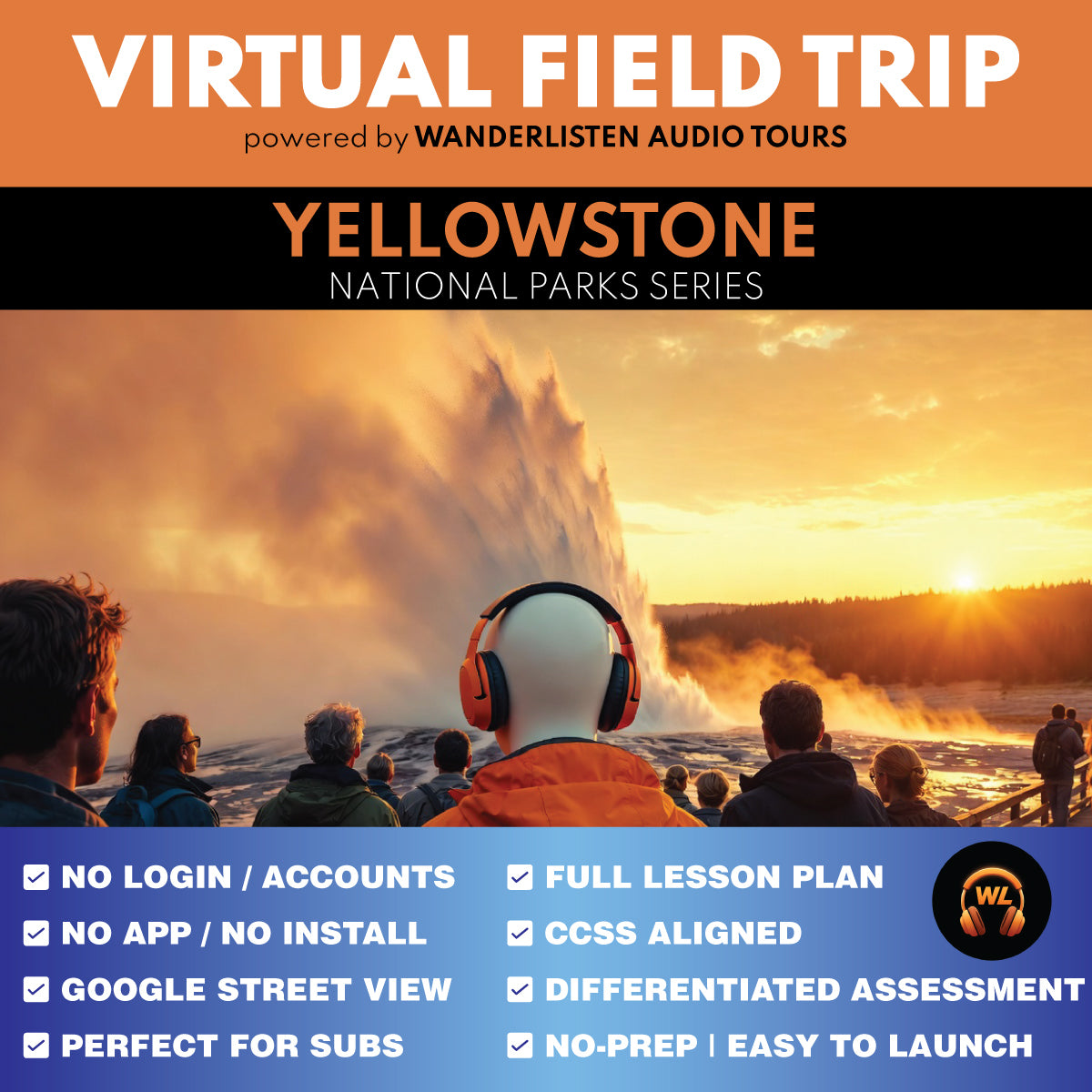
Take students into Yellowstone National Park with a completed 7-stop WanderListen virtual field trip that turns geysers, hot springs, canyon geology, wildlife systems, and public land into a place-based classroom lesson.
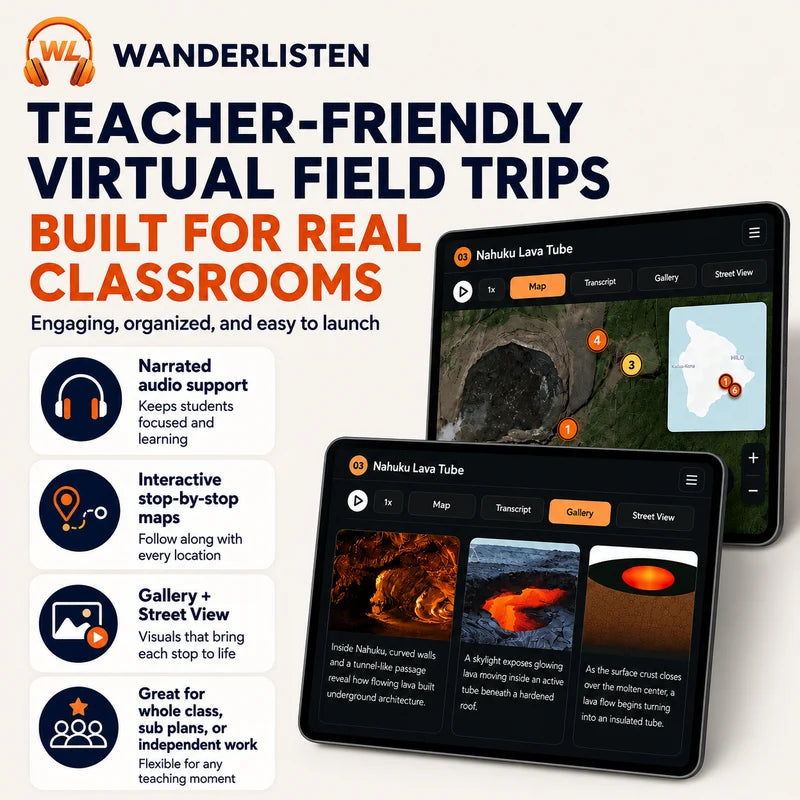
Students open a WanderListen app-style virtual field trip with narrated audio, map-based exploration, stop images, and classroom-ready response activities.
Try a complete WanderListen National Park lesson free first.
Get the Grand Canyon National Park Virtual Field Trip 100% FREE.
Teaching more than one park?
Get all 13 National Park virtual field trips in the complete WanderListen bundle.
What students practice
- Earth systems: how heat, water, rock, minerals, chemistry, pressure, erosion, and deposition shape Yellowstone over time.
- Visual evidence: how Old Faithful, Grand Prismatic Spring, Artist Point, Mammoth Hot Springs, West Thumb, and Roosevelt Arch help students connect what they see to scientific and civic ideas.
- Life science and ecology: how thermophiles, microbial mats, food webs, bison, wolves, habitat, and conservation recovery reveal linked living systems.
- Public lands and civic responsibility: how national parks involve preservation, access, Indigenous history, visitor pressure, scientific management, and competing responsibilities.
- Evidence-based writing: students cite tour evidence, explain cause and effect, interpret visual information, and support claims in short written responses.
What's included
- Completed WanderListen Yellowstone National Park Virtual Field Trip access through the shared Google folder
- Teacher Guide with pacing options, differentiation notes, print/digital setup, standards support, discussion prompts, and full answer key
- Student Worksheet for the 7 tour stops with one Stop Observation Question per stop
- End of Tour questions for systems thinking, visual evidence, geology, ecology, public lands, and personal reflection
- Vocabulary section with key terms from the tour, including transcript-based context
- Self-grading Google Forms multiple choice quiz
- Printable MC Quiz version
- Google Slides/PPTX worksheet and print worksheet versions
- Start Here PDF that helps teachers make their own Google Drive copies and unlock the tour
Flexible pacing
- 45-minute quick implementation: brief setup, full virtual field trip, one question per stop, and a short wrap-up or quiz.
- 60-70-minute guided lesson: more time for vocabulary, stop questions, map exploration, image-gallery observations, and review.
- 90-minute two-class option: tour first, then discussion, End of Tour questions, and assessment.
Best fit: Grades 6-8 and 9-12 Earth science, life science, geography, environmental science, ecology, public lands, conservation, national parks, and social studies enrichment.
Teacher note: This is a digital classroom resource built around a WanderListen virtual field trip experience. It is not a movie guide or YouTube clip lesson.
Share