

WanderListen
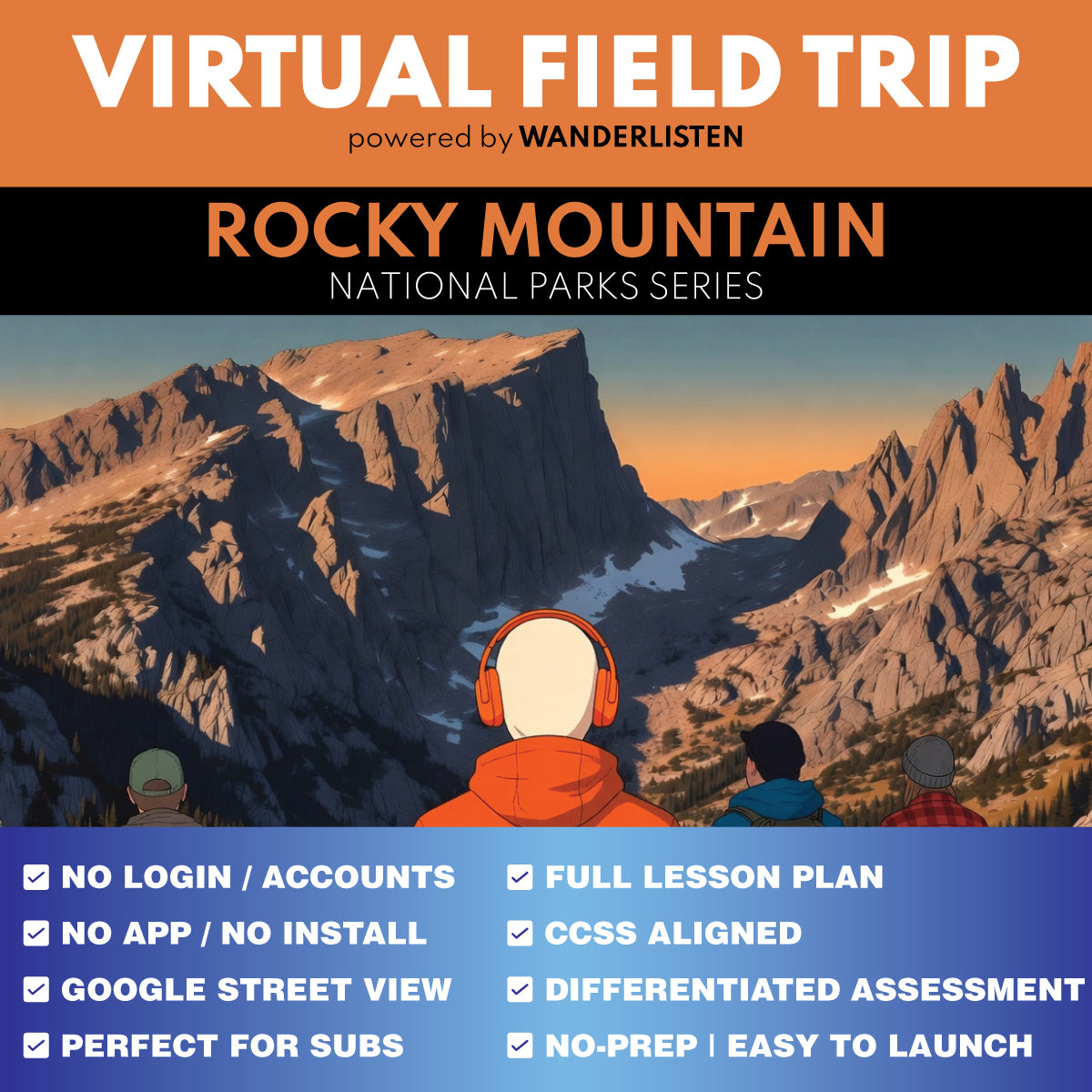
Rocky Mountain National Park Virtual Field Trip App Lesson | Audio + Map + Quiz
Rocky Mountain National Park Virtual Field Trip App Lesson | Audio + Map + Quiz
Couldn't load pickup availability
Classroom Use at a Glance
WanderListen Rocky Mountain National Park Virtual Field Trip lesson for grades 6-8 and 9-12. Includes an 8-stop app-style audio + map tour, teacher guide, student worksheet, answer key, vocabulary, discussion prompts, End of Tour questions, Google Slides/PPTX worksheet versions, self-grading Google Forms quiz, printable MC quiz, and Start Here PDF. Designed for a 45-minute quick implementation or a 90-minute two-class lesson.
- Resource type
- Virtual Field Trip Lesson
- Grade band
- Grades 6–8 Grades 9–12
- Rating
- Not Rated
- Runtime
- About 29 minutes tour audio minutes
- Time required
- 45-90 minutes
- Prep level
- No Prep
- Subject
- Science Social Studies
- Classroom use
- Sub Plans Whole-Class Instruction Independent Work Homework Discussion Assessment
- Includes
- Teacher Guide Student Worksheet Answer Key Discussion Questions Vocabulary Google Forms Quiz Google Slides/PPTX Printable Quiz Start Here PDF
- Tech format
- PDF Google Slides Google Forms Google Docs PPTX DOCX ZIP
Take students into Rocky Mountain National Park with a completed 8-stop WanderListen virtual field trip that turns glacial valleys, alpine tundra, watersheds, wildlife management, Indigenous and homestead history, high-mountain road engineering, and flood hazards into a place-based classroom lesson.
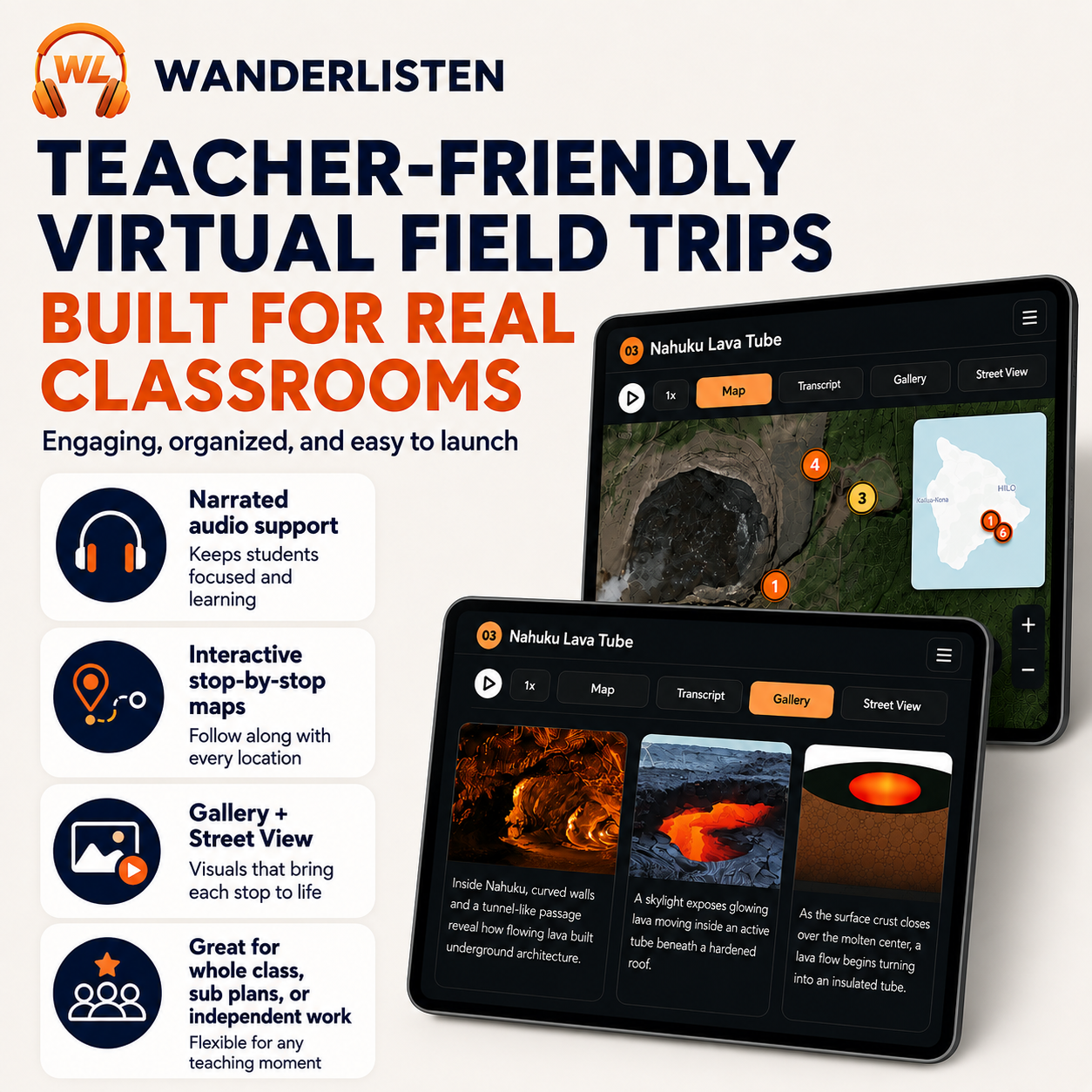
Students open a WanderListen app-style virtual field trip with narrated audio, map-based exploration, historical and scientific stop images, and classroom-ready response activities.
Try a complete WanderListen National Park lesson free first.
Get the Grand Canyon National Park Virtual Field Trip 100% FREE.
Teaching more than one park?
Get all 13 National Park virtual field trips in the complete WanderListen bundle.
What students practice
- Earth systems: how glaciers widen valleys and excavate bedrock, how elevation organizes forests and tundra, how snowmelt enters connected watersheds, and how floodwater transports and deposits sediment.
- Visual evidence: how Beaver Meadows, Moraine Park, Bear Lake, Many Parks Curve, Rock Cut, Milner Pass, Holzwarth Historic Site, and the Alluvial Fan connect visible features to geographic, ecological, historical, and engineering processes.
- Ecology and environmental management: how elk browsing affects willow habitat, how alpine plants survive above treeline, how long-term research guides tundra protection, and how managers respond to fragile landscapes and natural hazards.
- Cultural landscapes and public lands: how associated Tribal nations, Mission 66 architecture, homesteading, guest-ranch tourism, road building, water diversion, and dam removal complicate the idea of an untouched national park.
- Evidence-based writing: students cite tour evidence, explain cause and effect, compare processes at different scales, interpret maps and images, and support claims in short written responses.
What's included
- Completed WanderListen Rocky Mountain National Park Virtual Field Trip access through the shared Google folder
- Teacher Guide with pacing options, differentiation notes, print/digital setup, standards support, discussion prompts, and full answer key
- Student Worksheet for the 8 tour stops with one Stop Observation Question per stop
- End of Tour questions covering glacial geology, elevation, alpine ecology, watersheds, wildlife management, cultural history, engineering, and flood hazards
- Vocabulary section with key terms from the tour and transcript-based context
- Self-grading Google Forms multiple choice quiz
- Printable MC Quiz version
- Google Slides/PPTX worksheet and print worksheet versions
- Start Here PDF that helps teachers make their own Google Drive copies and unlock the tour
Flexible pacing
- 45-50-minute quick implementation: brief setup, full virtual field trip, one question per stop, and a short wrap-up or quiz.
- 60-75-minute guided lesson: more time for vocabulary, map exploration, historical images, watershed tracing, management decisions, and discussion.
- 90-minute two-class option: tour first, then discussion, End of Tour questions, and assessment.
Best fit: Grades 6-8 and 9-12 Earth and space science, life science, geography, environmental science, geology, watersheds, ecology, public lands, Indigenous history, national parks, Colorado history, and social studies enrichment.
Teacher note: This is a digital classroom resource built around a WanderListen virtual field trip experience. It is not a movie guide or YouTube clip lesson.
Share