
K12 Movie Guides
TED Talk Historical Judgment Full Curriculum | 13 Weeks
TED Talk Historical Judgment Full Curriculum | 13 Weeks
Couldn't load pickup availability
Classroom Use at a Glance
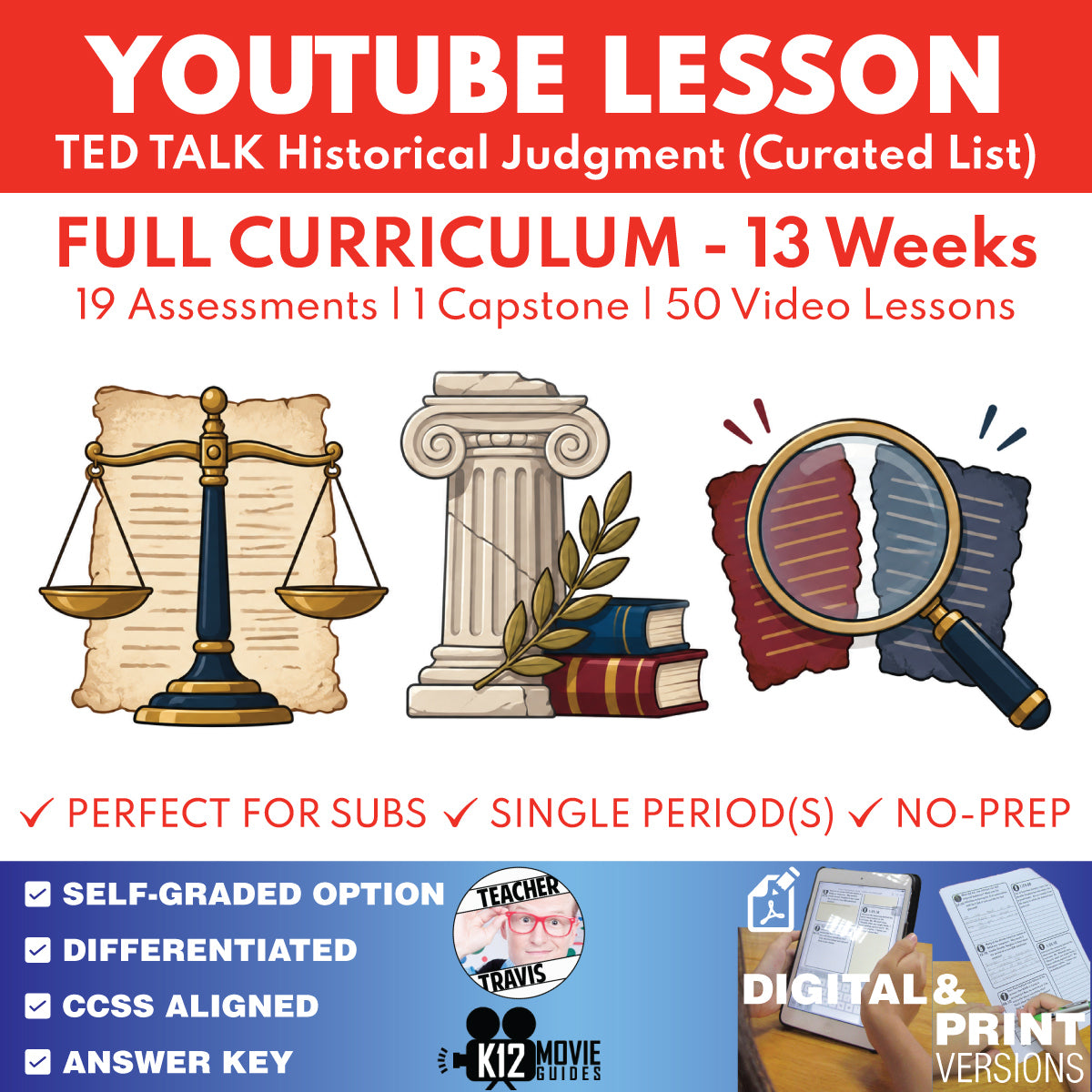
Complete 13-week Historical Judgment curriculum for grades 9–12 with 50 TED/TED-Ed video lessons, 12 weekly assessments, 6 unit assessments, cumulative Final, synthesis capstone, Educator Planning Guide, Student Syllabus, teacher guides, worksheets, answer keys, self-graded quizzes, and print/digital options.
- Resource type
- Full Curriculum Bundle
- Grade band
- Grades 9–12
- Rating
- Not Rated
- Time required
- 13-Week Curriculum; Flexible Pacing
- Prep level
- No Prep
- Subject
- Social Studies
- Classroom use
- Sub Plans Review Whole-Class Instruction Flipped Classroom Independent Work Curriculum Planning Assessment Planning Department Planning
- Includes
- Teacher Guide Student Worksheet Answer Key Google Forms Quiz Start Here PDF Educator Planning Guide Course Map Pacing Guide Assessment Overview Unit Overview Implementation Notes
- Tech format
- PDF Google Forms Google Docs Microsoft Word/DOCX Google Classroom Ready
Teach a complete 13-week high-school historical-judgment sequence with 50 TED/TED-Ed video lessons, six two-week units, weekly and unit assessment banks, a synthesis Capstone, and a cumulative Final.
FREE CURRICULUM SNEAK PEEK: Download the free Full Curriculum Educator Planning Guide.
Try an actual lesson free: Ugly History: Witch Hunts - FREE sample lesson.
Designed for Grades 9-12, the curriculum moves from judging powerful rulers and revolutions to empire, exclusion, state violence, and propaganda. Students separate evidence from inference, compare interpretations, examine source limits, trace responsibility, contextualize without excusing, and defend judgments with explicit criteria.
What's Included
- 50 individual TED/TED-Ed video lesson sets
- 12 weekly assessment sets (W01-W12)
- 6 cumulative unit assessment sets (U01-U06)
- 1 Full-Curriculum Capstone Synthesis Lesson
- 1 cumulative Final Assessment bank
- Educator Planning Guide
- Student Syllabus
- Teacher Guides, digital/print student materials, Self-Graded Quizzes, and MC Quiz Print ecosystem where appropriate
Course Structure
- Unit 1 - Power: Weeks 1-2
- Unit 2 - Revolution: Weeks 3-4
- Unit 3 - Empire: Weeks 5-6
- Unit 4 - Exclusion: Weeks 7-8
- Unit 5 - State Violence: Weeks 9-10
- Unit 6 - Propaganda: Weeks 11-12
- Week 13: Capstone synthesis and cumulative Final
All 50 Videos - Exact Titles and YouTube Links
Each title links directly to the public YouTube video so you can review exactly what is included in the course.
Unit 1 - Power
- History vs. Augustus - Peta Greenfield & Alex Gendler
- History vs. Cleopatra - Alex Gendler
- History vs. Egypt’s "most powerful" pharaoh - Jessica Tomkins
- History vs. Henry VIII - Mark Robinson and Alex Gendler
- History vs. Russia’s most infamous empress - Carolyn Harris
- History vs. Genghis Khan - Alex Gendler
- History vs. Andrew Jackson - James Fester
- History's deadliest king - by Georges Nzongola-Ntalaja
Unit 2 - Revolution
- Zumbi: The last king of Palmares - Marc Adam Hertzman & Flavio dos Santos Gomes
- What makes Thomas Jefferson so controversial? - Frank Cogliano
- History vs. Napoleon Bonaparte - Alex Gendler
- What is Juneteenth, and why is it important? - Karlos K. Hill and Soraya Field Fiorio
- History vs. Vladimir Lenin - Alex Gendler
- Why was India split into two countries? - Haimanti Roy
- History vs. Che Guevara - Alex Gendler
- What really happened during the Attica Prison Rebellion - Orisanmi Burton
- How did South African Apartheid happen, and how did it finally end? - Thula Simpson
Unit 3 - Empire
- Was Alexander the Great really that great? - Stephanie Honchell Smith
- History vs. Tamerlane the Conqueror - Stephanie Honchell Smith
- History vs. Christopher Columbus - Alex Gendler
- How one of the most profitable companies in history rose to power - Adam Clulow
- How one of the world’s richest companies rose to power - Shantel George
- The true cost of gold - Lyla Latif
- The dark history of the overthrow of Hawaii - Sydney Iaukea
- The records the British Empire didn't want you to see - Audra A. Diptée
Unit 4 - Exclusion
- Can stereotypes ever be good? - Sheila Marie Orfano and Densho
- The dark history of Mount Rushmore - Ned Blackhawk and Jeffrey D. Means
- The dark history of the Chinese Exclusion Act - Robert Chang
- Why was the US government obsessed with this animal? - Andrew C. Isenberg
- The movement that inspired the Holocaust - Alexandra Minna Stern and Natalie Lira
- Ugly History: Japanese American incarceration camps - Densho
- Ugly History: The U.S. Syphilis Experiment - Susan M. Reverby
- Why are US cities still so segregated? - Kevin Ehrman-Solberg and Kirsten Delegard
Unit 5 - State Violence
- Ugly History: The Spanish Inquisition - Kayla Wolf
- What really caused the Irish Potato Famine - Stephanie Honchell Smith
- One of the most controversial medical procedures in history - Jenell Johnson
- Ugly History: The Armenian Genocide - Ümit Kurt
- Ugly history: The 1937 Haitian Massacre - Edward Paulino
- Ugly History: The Khmer Rouge murders - Timothy Williams
- Ugly History: The El Mozote murders - Diana Sierra Becerra
- What caused the Rwandan Genocide? - Susanne Buckley-Zistel
- The Nazis recruited to win the Cold War - Brian Crim
Unit 6 - Propaganda
- Ugly History: Witch Hunts - Brian A. Pavlac
- What really happened during the Salem Witch Trials - Brian A. Pavlac
- The dark history of zombies - Christopher M. Moreman
- History vs. Sigmund Freud - Todd Dufresne
- Why is Marie Antoinette so controversial? - Carolyn Harris
- Mao Zedong's infamous mango cult - Vivian Jiang
- One of history's most dangerous myths - Anneliese Mehnert
- History vs. Richard Nixon - Alex Gendler
Assessment System
Each two-week unit includes two weekly assessment banks plus one cumulative unit assessment bank. Across six units, that provides 18 unit-level/weekly assessment banks. The course concludes with a separate cumulative Final, for 19 assessments total, plus the Week 13 Capstone synthesis lesson.
Capstone Synthesis
The Capstone introduces no new TED video. Students apply historical-judgment criteria to unfamiliar cases, compare evidence quality and competing interpretations, and defend a reasoned rule for responsible judgment across the course themes.
Flexible Classroom Use
Use the default 13-week sequence, compress selected lessons into block periods, spread the curriculum across a semester, or use individual two-week units as stand-alone history and social-studies modules. The Educator Planning Guide explains pacing and implementation options.
New Optional Video Companion (used with YouTube)
The free Classroom Video Guide Companion Chrome extension can automatically pause YouTube at question timestamps and display prompts during viewing. The curriculum works normally without the extension.
Prefer a 2-Week Unit?
- TED Talk Historical Judgment Unit 1 - Power | 2-Week Curriculum
- TED Talk Historical Judgment Unit 2 - Revolution | 2-Week Curriculum
- TED Talk Historical Judgment Unit 3 - Empire | 2-Week Curriculum
- TED Talk Historical Judgment Unit 4 - Exclusion | 2-Week Curriculum
- TED Talk Historical Judgment Unit 5 - State Violence | 2-Week Curriculum
- TED Talk Historical Judgment Unit 6 - Propaganda | 2-Week Curriculum
Frequently Asked Questions
Are the TED videos included?
No. Video files are not included; exact public YouTube links are provided.
Do I have to assign every assessment item?
No. The banks are intentionally larger than a typical one-period test so you can select what fits your students and calendar.
Is the Capstone another video lesson?
No. It is a cumulative synthesis activity with no new TED video.
Can the curriculum be shortened?
Yes. The Educator Planning Guide provides flexible pacing and implementation guidance.
Independent resource notice: TED/TED-Ed videos are not included. This is an independent educator-created companion curriculum and is not affiliated with or endorsed by TED.
Share
What’s inside this bundle:
-
 TED Talk Historical Judgment Unit 1 - Power | 2-Week Curriculum
 -
 TED Talk Historical Judgment Unit 2 - Revolution | 2-Week Curriculum
 -
 TED Talk Historical Judgment Unit 3 - Empire | 2-Week Curriculum
 -
 TED Talk Historical Judgment Unit 4 - Exclusion | 2-Week Curriculum
 -
 TED Talk Historical Judgment Unit 5 - State Violence | 2-Week Curriculum
 -
 TED Talk Historical Judgment Unit 6 - Propaganda | 2-Week Curriculum


