
K12MovieGuides
TED Talk Climate Change Full Curriculum | 12 Weeks
TED Talk Climate Change Full Curriculum | 12 Weeks
Couldn't load pickup availability
Classroom Use at a Glance
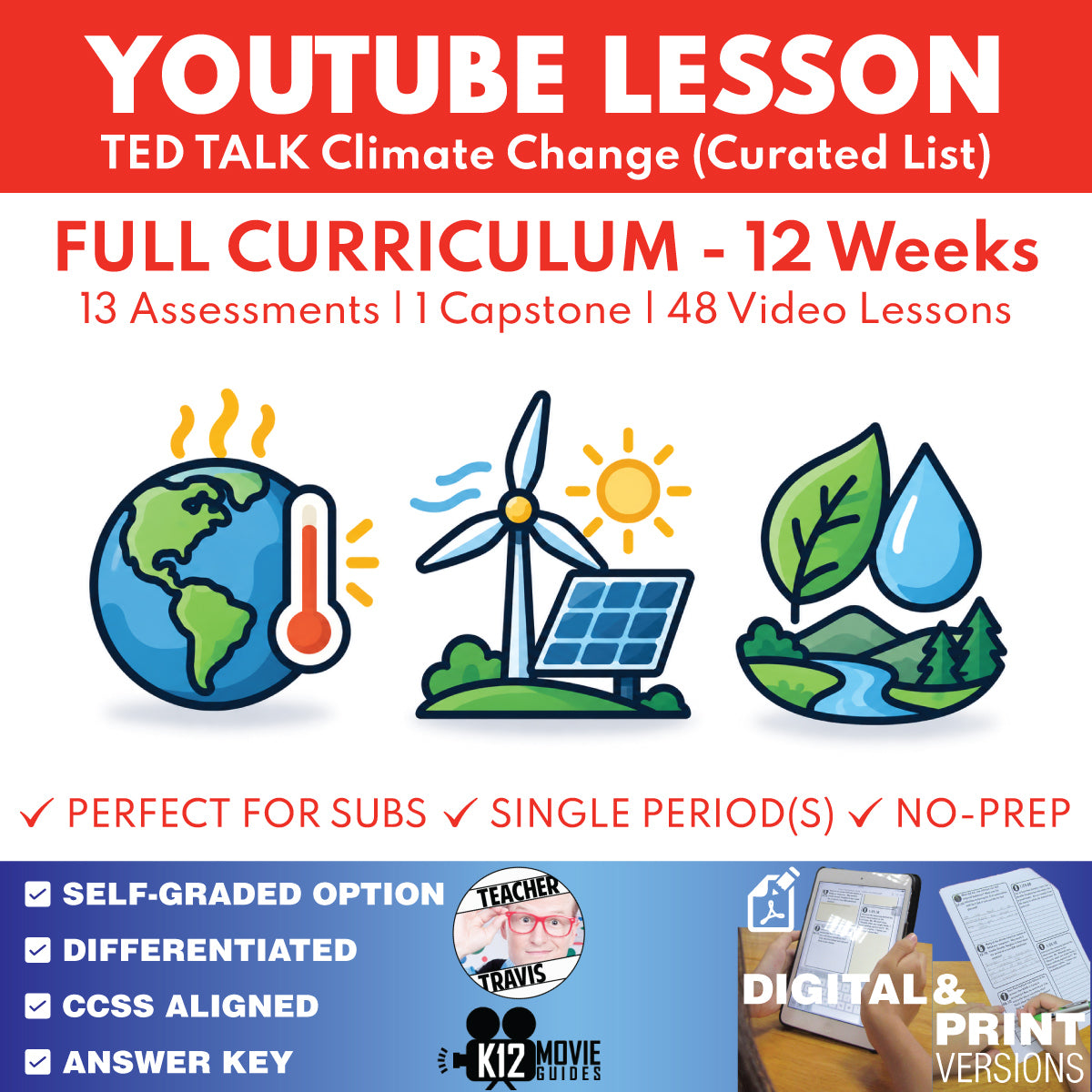
Complete 12-week Climate Change curriculum for grades 9–12 with 48 TED/TED-Ed video lessons, 6 weekly assessments, 6 unit assessments, cumulative final, synthesis capstone, Educator Planning Guide, Student Syllabus, teacher guides, worksheets, answer keys, self-graded quizzes, and print/digital options.
- Resource type
- Full Curriculum Bundle
- Grade band
- Grades 9–12
- Rating
- Not Rated
- Time required
- 12-Week Curriculum; Flexible Pacing
- Prep level
- No Prep
- Subject
- Science
- Classroom use
- Sub Plans Review Whole-Class Instruction Flipped Classroom Independent Work Curriculum Planning Assessment Planning Department Planning
- Includes
- Teacher Guide Student Worksheet Answer Key Google Forms Quiz Start Here PDF Educator Planning Guide Course Map Pacing Guide Assessment Overview Unit Overview Implementation Notes
- Tech format
- PDF Google Forms Google Docs Microsoft Word/DOCX Google Classroom Ready
Teach a complete 12-week high-school climate-change sequence with 48 TED/TED-Ed video lessons, six two-week units, weekly and unit assessment banks, a synthesis capstone, and a cumulative Final.
FREE CURRICULUM SNEAK PEEK: Download the free Full Curriculum Educator Planning Guide.
Try an actual lesson free: Earth's Giant Game of Tetris - FREE sample lesson.
Designed for Grades 9-12, the curriculum moves from climate mechanisms and energy systems to resource constraints, biodiversity, consumption, and solution evaluation. Students trace mechanisms, evaluate evidence, preserve uncertainty, identify system boundaries, compare tradeoffs, and apply climate concepts to unfamiliar cases.
What's Included
- 48 individual TED/TED-Ed video lesson sets
- 6 weekly assessment sets (W01, W03, W05, W07, W09, W11)
- 6 cumulative unit assessment sets (U01-U06)
- 1 Full-Curriculum Capstone Synthesis Lesson
- 1 cumulative Final Assessment bank
- Educator Planning Guide
- Student Syllabus
- Teacher Guides, digital/print student materials, Self-Graded Quizzes, and MC Quiz Print ecosystem where appropriate
Course Structure
- Unit 1 - Climate Science: Weeks 1-2
- Unit 2 - Energy: Weeks 3-4
- Unit 3 - Resources: Weeks 5-6
- Unit 4 - Biodiversity: Weeks 7-8
- Unit 5 - Consumption: Weeks 9-10
- Unit 6 - Climate Solutions: Weeks 11-12
All 48 Videos - Exact Titles and YouTube Links
Each title links directly to the public YouTube video so you can review exactly what is included in the course.
Unit 1 - Climate Science
- Climate change: Earth's giant game of Tetris - Joss Fong
- The carbon cycle - Nathaniel Manning
- Cloudy climate change: How clouds affect Earth's temperature - Jasper Kirkby
- How quantum mechanics explains global warming - Lieven Scheire
- How do ocean currents work? - Jennifer Verduin
- Is the weather actually becoming more extreme? - R. Saravanan
- Is our climate headed for a mathematical tipping point? - Victor J. Donnay
- What happens when the Arctic permafrost melts? - Brendan Rogers and Jessica Howard
Unit 2 - Energy
- 4 different ways you can power a car
- Can 100% renewable energy power the world? - Federico Rosei and Renzo Rosei
- How do wind turbines work? - Rebecca J. Barthelmie and Sara C. Pryor
- How much electricity does it take to power the world?
- How much land does it take to power the world?
- How scientists turn lakes into giant batteries
- Iceland's secret power - Jean-Baptiste P. Koehl
- How close are we to powering the world with nuclear fusion? - George Zaidan
Unit 3 - Resources
- Are we running out of clean water? - Balsher Singh Sidhu
- Can we create the "perfect" farm? - Brent Loken
- How the water you flush becomes the water you drink - Francis de los Reyes
- This is how nomadic farmers live
- Underwater farms vs. climate change - Ayana Elizabeth Johnson and Megan Davis
- What would happen if everyone stopped eating meat tomorrow? - Carolyn Beans
- Why is rice so popular? - Carolyn Beans
- Why don't we get our drinking water from the ocean? - Manish Kumar
Unit 4 - Biodiversity
- Can wildlife adapt to climate change? - Erin Eastwood
- Is the Amazon Rainforest disappearing? - Anna Rothschild
- The big-beaked, rock-munching fish that protect coral reefs - Mike Gil
- The last living members of an extinct species - Jan Stejskal
- The magical forest realm hiding at the bottom of the ocean - Luka Seamus Wright and Salomé Buglass
- The sharks that hunt in forests - Luka Seamus Wright
- Why is biodiversity so important? - Kim Preshoff
- Will the ocean ever run out of fish? - Ayana Elizabeth Johnson and Jennifer Jacquet
Unit 5 - Consumption
- A brief history of plastic
- Confused about recycling? It's not your fault - Shannon Odell
- Food expiration dates don't mean what you think - Carolyn Beans
- How much does it cost to fly private? - Rachel Yang
- The material that could change the world... for a third time
- The nurdles' quest for ocean domination - Kim Preshoff
- The wildly complex anatomy of a sneaker - Angel Chang
- What's a smartphone made of? - Kim Preshoff
Unit 6 - Climate Solutions
- Does planting trees actually cool the planet? - Carolyn Beans
- How Japan saved its biggest city from collapse - Roman Krznaric
- How to grow a glacier - M Jackson
- The surprising way we can cool the planet - Elise Cutts
- What Earth in 2050 could look like - Shannon Odell
- Why isn't the Netherlands underwater? - Stefan Al
- The "myth" of the boiling frog
- Why good ideas get trapped in the valley of death - and how to rescue them
Assessment System
Each two-week unit includes one weekly assessment bank after the first four lessons and one cumulative unit bank after the next four. Unit 6 includes U06 for teachers using Climate Solutions as a standalone product. In the Full Curriculum, the cumulative Final is the default Week 12 Day 5 closeout; teachers may use U06 as an alternate or targeted Unit 6 checkpoint.
Capstone Synthesis
The separate Capstone introduces no new video. Students evaluate unfamiliar climate-solution cases using evidence, mechanism, tradeoffs, uncertainty, and criteria drawn from all six units. It can be used as an alternative or complementary performance task.
Flexible Classroom Use
Use the default 12-week sequence, compress to a six-week intensive, run an eight- or nine-week accelerated version, or spread one to three TED lessons per week across a semester. The Educator Planning Guide explains how to preserve the core reasoning targets while reducing optional discussion or assessment-bank size.
New Optional Video Companion (used with YouTube)
The free Classroom Video Guide Companion Chrome extension can automatically pause YouTube at question timestamps and display prompts during viewing. It can make whole-class, small-group, and independent video lessons easier to facilitate. The curriculum works normally without the extension.
Prefer a 2-Week Unit?
- TED Talk Climate Change Unit 1 - Climate Science | 2-Week Curriculum
- TED Talk Climate Change Unit 2 - Energy | 2-Week Curriculum
- TED Talk Climate Change Unit 3 - Resources | 2-Week Curriculum
- TED Talk Climate Change Unit 4 - Biodiversity | 2-Week Curriculum
- TED Talk Climate Change Unit 5 - Consumption | 2-Week Curriculum
- TED Talk Climate Change Unit 6 - Climate Solutions | 2-Week Curriculum
Frequently Asked Questions
Are the TED videos included?
No. Video files are not included; exact public YouTube links are provided.
Do I have to assign every assessment item?
No. The banks are intentionally larger than a typical one-period test so you can select what fits your students and calendar.
Is the Capstone another video lesson?
No. It is a case-based cumulative synthesis activity with no new TED video.
Can the curriculum be shortened?
Yes. The Educator Planning Guide includes six-week intensive, eight- or nine-week accelerated, semester-supplement, and credit-recovery/summer options.
Independent resource notice: TED/TED-Ed videos are not included. This is an independent educator-created companion curriculum and is not affiliated with or endorsed by TED.
Share
What’s inside this bundle:
-
 TED Talk Climate Change Unit 1 - Climate Science | 2-Week Curriculum
 -
 TED Talk Climate Change Unit 2 - Energy | 2-Week Curriculum
 -
 TED Talk Climate Change Unit 3 - Resources | 2-Week Curriculum
 -
 TED Talk Climate Change Unit 4 - Biodiversity | 2-Week Curriculum
 -
 TED Talk Climate Change Unit 5 - Consumption | 2-Week Curriculum
 -
 TED Talk Climate Change Unit 6 - Climate Solutions | 2-Week Curriculum


