
K12 Movie Guides
Piper Formal Observation Lesson Pack | Georgia TKES/TAPS | Grades 3-5
Piper Formal Observation Lesson Pack | Georgia TKES/TAPS | Grades 3-5
Couldn't load pickup availability
Classroom Use at a Glance
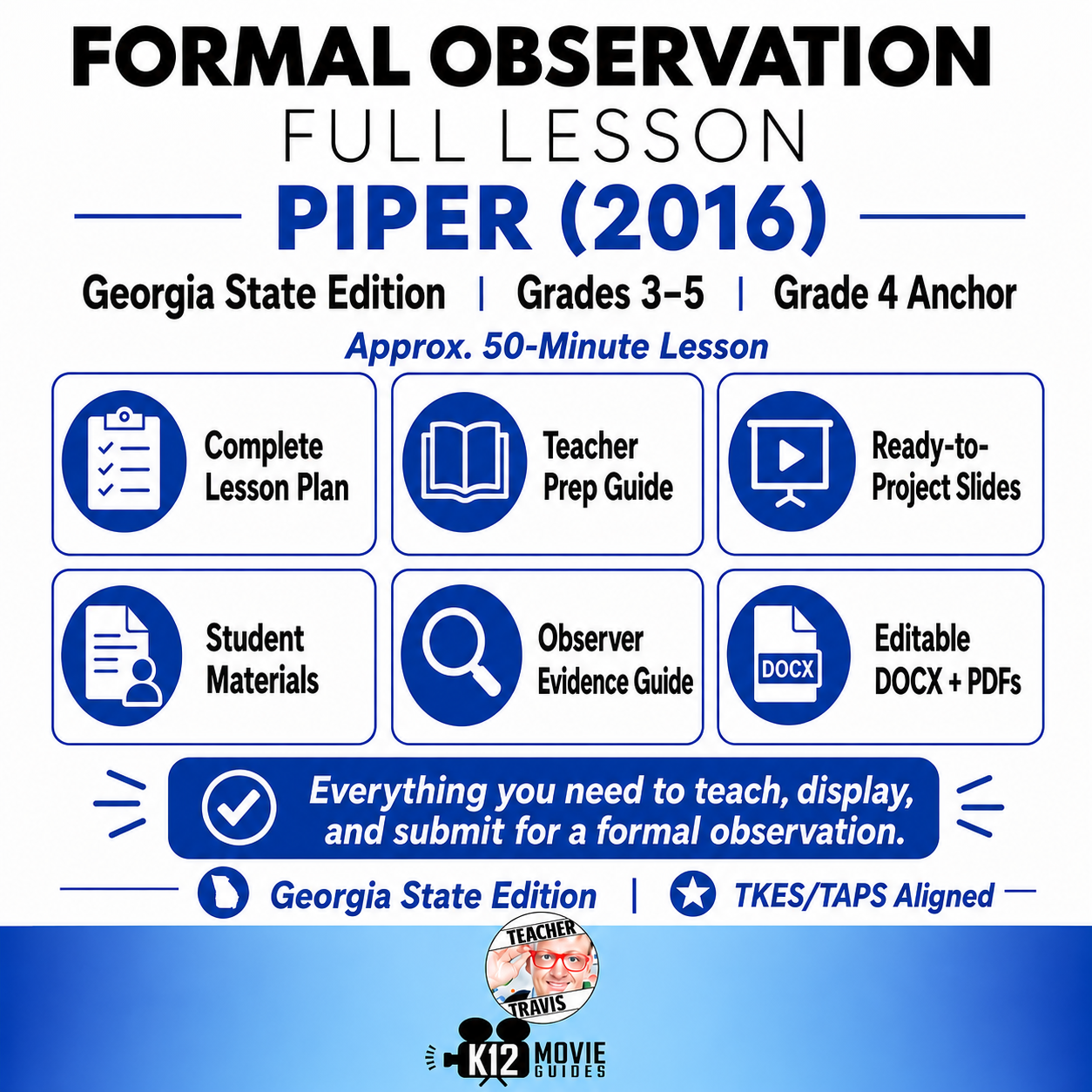
Georgia-specific Piper formal observation lesson aligned to current Georgia K-12 ELA standards and TKES/TAPS, with submission plan, projection slides, student work, and teacher preparation.
- Resource type
- Formal Observation Lesson Pack
- Grade band
- Grades 3–5
- Runtime
- 6 minutes
- Time required
- 1 Class Period (45-55 Minutes)
- Prep level
- Low-Prep
- Subject
- ELA
- Classroom use
- Formal Observation ELA Lesson Visual Text Analysis Evidence-Based Discussion Student Writing Teacher Evaluation Preparation
- Includes
- Student Worksheet Teacher Guide Answer Key Discussion Questions Lesson Plans Projection Slides Observer Evidence Guide Editable DOCX PowerPoint / PPTX PDF
- Tech format
- Printable Worksheet Editable DOCX PowerPoint / PPTX PDF
Walk into a formal observation with the lesson plan, display prompts, student work, and teacher preparation already organized.
This Piper Formal Observation Lesson Pack turns the approximately six-minute wordless animated short into a complete 45-55 minute Grades 3-5 ELA lesson. Students do more than watch: they notice visual details, make and revise inferences, explain character motivation and response, compare problem-solving strategies, build a theme statement, discuss evidence, and produce visible written learning.
The pack is designed especially for new and early-career teachers who may feel anxious about a formal observation. The submitted lesson plan is a clean professional document. A separate private teacher guide explains how to prepare, rehearse, answer pre-conference questions, respond when students are quiet, monitor and adjust during the lesson, and describe the learning evidence afterward.
Will this meet your needs?
Georgia TKES/TAPS edition
This Georgia Edition aligns the lesson to Georgia's current K-12 ELA standards and the Teacher Keys Effectiveness System / Teacher Assessment on Performance Standards. The lesson makes planning, instructional strategies, differentiated instruction, assessment strategies and uses, communication, and an academically challenging environment visible through student work.
The private teacher guide includes Georgia pre-conference talking points, likely student responses, TAPS-aligned rescue moves, post-conference reflection language, and a practical observation-day quick card. A Georgia standards and evaluation research dossier is included.
Everything students need to see is already prepared
The included PowerPoint and PDF projection deck displays the opening hook, learning intention, success criteria, guided pause questions, discussion directions, and closure prompt. Teachers do not need to create a separate presentation or copy questions onto the board.
The questioning sequence is adapted from the original K12MovieGuides Piper guide and rebuilt for a high-stakes observation. Each prompt begins with something students can notice or choose, then moves them toward evidence, inference, reasoning, comparison, and revision.
- Opening: How can a video tell a story without words or dialogue?
- About 1:05 - Piper and Mom: What does Piper expect from Mom, and what does Mom do that shows Piper needs to try something herself?
- About 1:55 - The wave: Which visual clues show what happened, and what do those details suggest about Piper now?
- About 3:30 - The hermit crab: What does Piper learn, and what does Piper notice that changes the way she handles the next wave?
- About 4:15 - Character change: At first Piper ____. By the end Piper ____. Which visual detail proves that change most clearly?
- Closure: What larger lesson does the story teach, and how is Piper's solution different from the other birds' solution?
The lesson intentionally mixes silent writing, partner rehearsal, whole-class discussion, evidence ranking, independent revision, and an exit response. This creates broad participation and visible intellectual engagement instead of relying on a few volunteers.
What is included
- Editable formal observation lesson plan in DOCX plus print-ready PDF
- Inside the Observation Teacher Preparation Guide in DOCX and PDF
- Observer Evidence Guide that identifies what an evaluator can see and hear
- Projection slide deck in editable PPTX and ready-to-display PDF
- Grades 3-5 student materials in editable DOCX and printable PDF
- Guided questions, likely student responses, differentiation, monitor-and-adjust moves, closure, and post-conference reflection support
What an administrator can observe
- A clear learning intention and student-friendly success criteria
- Questions that move from accessible noticing to higher-order interpretation
- Students citing exact visual details rather than retelling the plot
- Structured student discourse and multiple ways to participate
- Formative assessment at each pause point
- Teacher decisions based on student responses
- Differentiation for students who need writing, language, or processing support
- Student agency through evidence selection, comparison, self-checking, and revision
- A purposeful closure that consolidates learning and produces an exit artifact
Grade-specific rigor for Grades 3-5
- Grade 3: identify a relevant visual detail and explain what it shows.
- Grade 4 anchor: combine evidence, explain character response, and build a complete theme statement.
- Grade 5: compare evidence, defend the strongest interpretation, and revise analytical writing.
Best for
- Formal or announced observations
- Pre-conference lesson-plan submission
- New-teacher induction and mentoring
- ELA lessons on visual inference, character response, character change, and theme
- Classes that benefit from a short, highly engaging central text
- One 45-55 minute class period
Free preview available
The editable Inside the Observation Teacher Guide DOCX is available as a free preview on this product page. It explains how the full lesson works, what to prepare, how the questions are expected to land with students, what to say in a pre-conference, how to recover if students are quiet, and how to describe evidence of learning afterward. The complete paid pack adds the formal lesson plan, student materials, projection deck, observer evidence guide, and all editable/print-ready files.
Only need the original Piper video guide?
View the Piper (2016) Pixar Short Video Guide.
Film access
The film is not included. Teachers and students must access Piper separately through a lawful classroom viewing method. Pause times are approximate and may vary slightly by platform or version.
Copyright and trademark notice
This independent, educator-created resource is a supplemental lesson for criticism, discussion, and educational analysis. It is not affiliated with, endorsed by, sponsored by, or authorized by Pixar, Walt Disney Studios, or related rights holders. The film title is used only to identify the short studied. No film clips, movie stills, character artwork, logos, or proprietary media are included. All trademarks and copyrights remain the property of their respective owners.
Share