
K12 Movie Guides
Mystery Doug - Why Can't We Remember Being Babies - YouTube Video Lesson
Mystery Doug - Why Can't We Remember Being Babies - YouTube Video Lesson
Couldn't load pickup availability
Classroom Use at a Glance
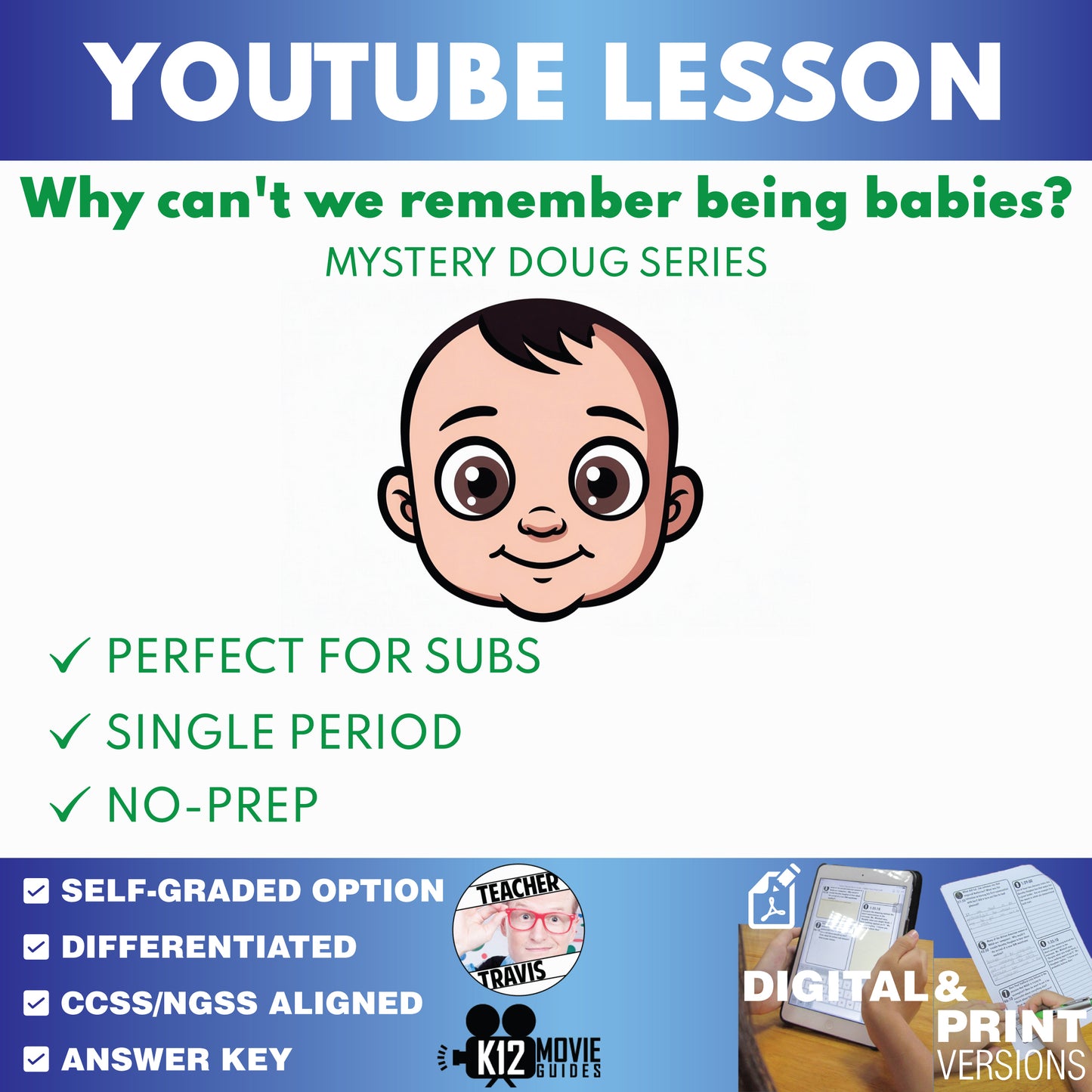
Short Mystery Doug YouTube lesson companion for teaching memory and the human body with worksheet questions, vocabulary, and digital quiz options.
- Resource type
- Short Video Lesson
- Grade band
- Grades 3–5 Grades 6–8
- Rating
- Not Rated
- Runtime
- 9 minutes
- Time required
- One Class Period
- Prep level
- No-Prep
- Subject
- Science ELA
- Classroom use
- Science Extension ELA Skill Practice Sub Plans Digital Assignment Early Finishers / Enrichment
- Includes
- Student Worksheet Short-Answer Questions Multiple-Choice Quiz Answer Key Vocabulary
- Tech format
- Printable PDF Google Slides Google Forms Quiz Google Classroom Ready
Need a quick video-based activity that is easy to access and ready when your lesson plan suddenly changes? This Mystery Doug YouTube video lesson turns the short clip Why Can't We Remember Being Babies? into a focused, no-prep worksheet students can complete before, during, and after viewing.
This resource is built for the reality of a busy classroom: a 5-10 minute YouTube clip, a clear student worksheet, a teacher answer key, Google Classroom options, and a 10-question self-graded quiz. It is perfect in a pinch for subs, early finishers, science centers, enrichment, or a short media-based lesson.
Students use the clip to practice listening for evidence, explaining key ideas, and responding in complete sentences. The questions stay focused on memory, event memory, language, caregivers, recognition, babies, brain development, and evidence instead of turning a short YouTube clip into a full-length movie assignment.
Will this lesson meet your needs?
Try the Mystery Doug shark video lesson first for FREE
Classroom Use at a Glance
- Best for: Grades 3-8 human body, brain science, memory, information processing, sub plans, and quick evidence-based discussion
- Use cases: human body mini-lesson, brain and memory discussion, evidence-based video response, sub plan, early-finisher task, science center, or Google Classroom assignment
- Key concepts: memory, event memory, language, caregivers, recognition, babies, brain development, and evidence
- Skills addressed: information processing, memory vocabulary, main idea and details, compare and contrast, evidence-based explanation, discussion
- Standards support: CCSS evidence-based reading, vocabulary, discussion, and writing, plus NGSS 4-LS1-2 support for information processing through senses, the brain, memory, and behavior.
- Differentiation: students can complete the written video guide or use the 10-question multiple-choice quiz as a faster, lower-writing assessment option
- Time needed: about 20-45 minutes total, depending on whether you use the quick clip activity, written responses, discussion, or the quiz
- Formats included: printable worksheet, Google Slides/PPTX worksheet, Google Forms quiz, teacher guide, answer keys, CCSS alignment, and Start Here / Google Classroom link PDF
Guidance & Summary
Why Can't We Remember Being Babies? is a short Mystery Doug science explainer video. Teachers should preview the video and confirm that the topic, pacing, and discussion questions fit their students and local classroom needs.
Students examine why adults often do not remember being babies while also learning that babies can still remember some things in different ways.
This guide is designed to help students practice close viewing, vocabulary in context, evidence-based answers, and classroom discussion while keeping the lesson short enough for one class period.
Video link: https://www.youtube.com/watch?v=VJEfCpD5X10
Why Teachers Use This YouTube Video Lesson
This clip works because students usually have a personal connection to the question. The worksheet turns that curiosity into a short science lesson about memory, language, recognition, and evidence.
Because the video is short and easy to access, it can fill a real classroom need: a meaningful activity that does not require a full film, a lab setup, or a long unit plan. Students still have to use evidence and explain their thinking, but the lesson stays manageable for one class period.
Differentiation Options
The teacher guide includes a written-response path and a multiple-choice quiz path.
Use the written worksheet when students are ready to explain ideas, define vocabulary in context, and support answers with details from the clip. Use the 10-question multiple-choice quiz when students need fewer writing demands, a faster check for understanding, or a sub-friendly assessment option.
Support options include reading questions aloud, pausing the video at the listed time stamps, allowing students to answer in pairs, offering extended time, or asking selected students to explain a few answers orally.
What’s Included
Student Materials
- Vocabulary words tied directly to the YouTube clip
- 4 chronological, time-stamped short-answer questions
- 2 end-of-video challenge questions
- 10-question multiple-choice quiz (Self-Graded Google Forms)
Teacher Materials
- Teacher’s guide and short lesson plan
- Worksheet & MC Quiz answer key
- CCSS alignment
- Pre- and post-viewing discussion questions
- Print and digital implementation guidance
Digital & Print Options
- All materials have Google Classroom and print options
- Includes Google Slides/PPTX worksheet files and a Google Forms multiple-choice quiz
Flexible Lesson Pacing
- Quick Watch & Discuss: best for a short warm-up, bell-ringer, or emergency sub activity
- Pause-and-Write: best for using the time-stamped questions during the video
- Full One-Class Lesson: best for vocabulary, viewing, written responses, discussion, and the MC quiz
The teacher guide includes these pacing paths, plus options for written responses or the multiple-choice quiz as an alternate assessment.
Skills Addressed
- information processing
- memory vocabulary
- main idea and details
- compare and contrast
- evidence-based explanation
- discussion
Frequently Asked Questions
Can I use this as a sub plan?
Yes. The YouTube clip is short, the worksheet is structured, and the teacher guide includes answer keys, so it can work as a planned lesson or a reliable sub plan.
Does this include a digital version?
Yes. The resource includes Google Slides/PPTX worksheet materials and a Google Forms version of the multiple-choice quiz.
Is there an answer key?
Yes. The teacher guide includes worksheet answers and the multiple-choice quiz answer key.
How long does the resource take?
Plan for the 5-10 minute video plus about 20-45 minutes for vocabulary, questions, discussion, and written work.
How is this differentiated?
Students can complete the written-response video guide or use the 10-question multiple-choice quiz as a lower-writing alternate assessment.
Copyright & Trademark Disclaimer
This independent, educator-created video lesson is a supplemental classroom resource for discussion, evidence-based writing, and educational analysis. It is not affiliated with, endorsed by, sponsored by, or authorized by Mystery Science, Mystery Doug, YouTube, or any related rights holders. The video title is used only to identify the public video studied. No video clips, screenshots, logos, transcript text, or proprietary media from the video are included, reproduced, adapted, or distributed in this resource. Teachers and students must access the video separately through the official platform.
Share