
K12 Movie Guides
How to Compare and Contrast | Crash Course Kids YouTube Video Lesson | No-Prep
How to Compare and Contrast | Crash Course Kids YouTube Video Lesson | No-Prep
Couldn't load pickup availability
Classroom Use at a Glance
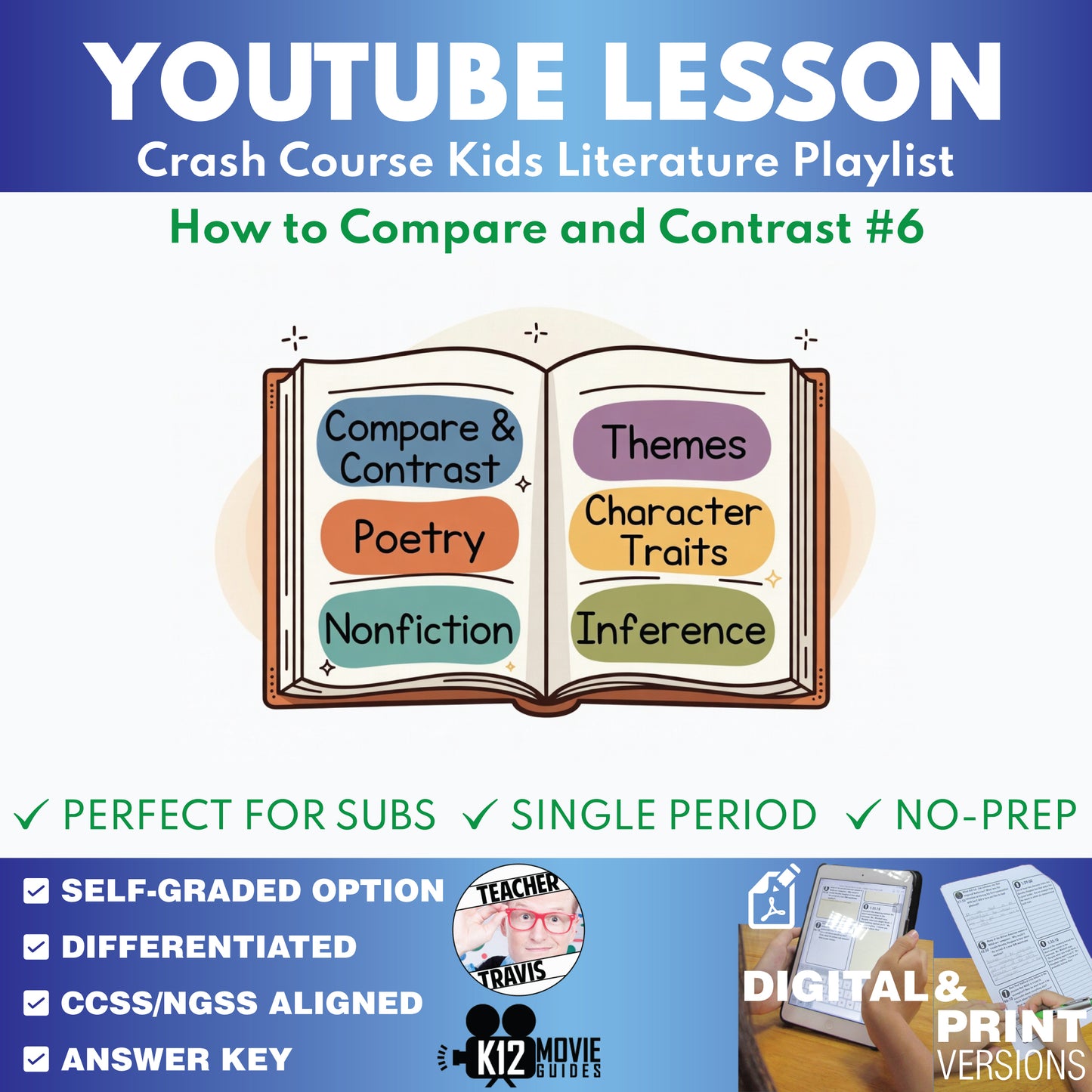
No-prep How to Compare and Contrast - Crash Course Kids YouTube Video Lesson - No-Prep with student worksheet, teacher guide, answer key, quiz, and Google Classroom-ready materials.
- Resource type
- YouTube Video Lesson
- Grade band
- Grades 3–5
- Rating
- Not Rated
- Runtime
- 6 minutes
- Time required
- 20-45 minutes
- Prep level
- No-Prep
- Subject
- ELA
- Classroom use
- Guided Video Lesson ELA Skill Practice Sub Plans Early Finisher Activity Google Classroom Assignment
- Includes
- Student Worksheet Teacher Guide Answer Key Vocabulary Questions Short-Answer Questions Multiple-Choice Quiz Google Forms Quiz Google Slides/PPTX
- Tech format
- Printable PDF Google Slides PowerPoint/PPTX Google Forms Google Docs Google Classroom Ready ZIP File
Need a quick compare-and-contrast activity that helps students go beyond listing same and different? This Crash Course Kids YouTube video lesson turns the short clip "How to Compare and Contrast" into a focused, no-prep worksheet students can complete before, during, and after viewing.
This resource is built for the reality of a busy classroom: a short YouTube clip, a clear student worksheet, a teacher answer key, Google Classroom options, and a 10-question self-graded quiz. It is perfect for subs, reading centers, traditional-literature review, early finishers, or a short ELA mini-lesson.
Students use the clip to practice comparing story versions, identifying similarities and differences, and explaining why a change in character, setting, problem, or lesson can matter. The questions stay focused on comparison skills instead of treating a short YouTube clip like a full-length movie assignment.
Crash Course Kids playlist: Teachers and students access the public video separately on YouTube. Open the Crash Course Kids Literature playlist here.
Try it free first: Will this lesson meet your needs? Download the free What Is an Inference? Crash Course Kids YouTube Video Lesson first and see the format before purchasing this lesson.
Classroom Use at a Glance
- Best for: Grades 3-5 ELA, compare and contrast, traditional literature, fairy tales, reading comprehension, sub plans, literacy centers, and quick evidence-based discussion
- Use cases: YouTube clip lesson, compare-and-contrast mini-lesson, fairy-tale review, sub plan, early-finisher activity, literacy center, test-prep practice, or Google Classroom assignment
- Key concepts: compare, contrast, similarities, differences, story versions, traditional literature, characters, setting, problem, lesson, and evidence
- Skills addressed: comparing texts, contrasting story details, explaining why differences matter, vocabulary in context, discussion, and short written response
- Differentiation: students can complete the written video guide or use the 10-question multiple-choice quiz as a faster, lower-writing assessment option
- Time needed: about 20-45 minutes total, depending on whether you use the quick clip activity, written responses, discussion, or the quiz
- Formats included: printable worksheet, Google Slides/PPTX worksheet, Google Forms quiz, teacher guide, answer keys, CCSS alignment, and Start Here / Google Classroom link PDF
- ELA category: Reading Comprehension - Compare and Contrast
- Standards support: CCSS Support: CCRA.R.1, CCRA.R.2, CCRA.R.3, CCRA.R.9, CCRA.L.4, CCRA.SL.1, and CCRA.W.2. The strongest fit is comparing texts or story versions: students identify similarities and differences and support their thinking with specific details.
Why Teachers Use This YouTube Video Lesson
This Crash Course Kids clip works especially well when students need a concrete way to compare two versions of a familiar story. The worksheet helps them look for meaningful similarities and differences instead of stopping at surface-level details.
Because the video is short and easy to access, it can support a traditional-literature unit, test-prep review, or sub plan without requiring a long reading packet. Students still practice the important skill: using details to explain how two versions are alike, different, and meaningful.
Differentiation Options
The teacher guide includes a written-response path and a multiple-choice quiz path.
Use the written worksheet when students are ready to explain ideas, define vocabulary in context, and support answers with details from the clip. Use the 10-question multiple-choice quiz when students need fewer writing demands, a faster check for understanding, or a sub-friendly assessment option.
Support options include reading questions aloud, pausing the video at the listed time stamps, allowing students to answer in pairs, offering extended time, or asking selected students to explain a few answers orally.
What's Included
Student Materials
Vocabulary words tied directly to the YouTube clip
4 chronological, time-stamped short-answer questions
2 end-of-video challenge questions
10-question multiple-choice quiz (Self-Graded Google Forms)
Teacher Materials
Teacher's guide and short lesson plan
Worksheet & MC Quiz answer key
CCSS alignment
Pre- and post-viewing discussion questions
Print and digital use directions
Digital & Print Options
All materials have Google Classroom and print options
Includes worksheet slides/PPTX and a print-friendly worksheet version
Includes a Start Here PDF with the Google Classroom link for this product
Flexible Clip Pacing
Quick 20-Minute Use: play the clip, use one pre-viewing question, and assign the multiple-choice quiz as a fast check for understanding
Standard 30-Minute Lesson: use the pre-viewing prompt, watch the clip, complete the time-stamped questions, and discuss one post-viewing question
40-45 Minute Sub Plan: use the full worksheet, vocabulary section, challenge questions, and quiz for a complete one-period activity
The teacher guide keeps the lesson short and flexible, so you can use the clip as a quick ELA activity, a planned mini-lesson, or an emergency sub plan.
Skills Addressed
Compare and contrast
Similarities and differences
Traditional literature
Story versions
Character and setting
Problem and lesson
Evidence-based response
Vocabulary in context
Listening comprehension
Short written response
CCSS Alignment
CCSS Support: CCRA.R.1, CCRA.R.2, CCRA.R.3, CCRA.R.9, CCRA.L.4, CCRA.SL.1, and CCRA.W.2. The strongest fit is comparing texts or story versions: students identify similarities and differences and support their thinking with specific details.
Use this alignment as lesson support rather than a claim that one short video companion fully satisfies every part of a standard by itself. The strongest fit is the student work: vocabulary in context, evidence-based short answers, discussion, and written explanation.
Frequently Asked Questions
Is there a free sample I can try first?
Yes. Try the free What Is an Inference? Crash Course Kids YouTube Video Lesson first. It uses the same general format so you can preview the resource style before purchasing this lesson.
Can I use this as a sub plan?
Yes. The video is short, accessible on YouTube, and paired with structured questions, answer keys, and a 10-question quiz, so it works well for planned instruction or a last-minute sub plan.
Does this include the YouTube video?
No. This is an educator-created companion resource. Teachers and students access the Crash Course Kids video separately on YouTube.
Does this include a digital version?
Yes. The resource includes Google Slides/PPTX worksheet materials and a Google Forms version of the multiple-choice quiz.
Is there an answer key?
Yes. The teacher guide includes worksheet answers and the multiple-choice quiz answer key.
How long does the resource take?
Plan for about 20-45 minutes depending on how much discussion, writing, and quiz time you want to include.
How is this differentiated?
Students can complete the written-response video guide or use the 10-question multiple-choice quiz as an alternate assessment with fewer writing demands.
Copyright & Trademark Disclaimer: This independent, educator-created video companion is a supplemental classroom resource for discussion, comprehension, and educational analysis. It is not affiliated with, endorsed by, sponsored by, or authorized by Crash Course, Crash Course Kids, Complexly, YouTube, or any related rights holders. The video title is used only to identify the publicly accessible video studied. No video clips, screenshots, thumbnails, logos, transcript text, or other proprietary media from the video are included, reproduced, adapted, or distributed in this resource. Teachers and students must access the video separately through lawful classroom viewing methods. All trademarks and copyrights remain the property of their respective owners.
Share