

K12 Movie Guides
Frankenstein Movie Guide Questions & Worksheet (2025)
Frankenstein Movie Guide Questions & Worksheet (2025)
Couldn't load pickup availability
Classroom Use at a Glance
No-prep movie guide for Frankenstein with time-stamped questions, discussion prompts, answer keys, and a self-grading Google Forms quiz.
- Resource type
- Film Quiz & Movie Guide
- Grade band
- Grades 9–12
- Rating
- R
- Runtime
- 149 minutes
- Time required
- 3–5 Class Periods
- Prep level
- No-Prep
- Subject
- ELA
- Classroom use
- Full Film Lesson Movie Day Accountability Discussion Evidence-Based Writing Film Analysis Digital Assignment Science Extension
- Includes
- Student Worksheet Time-Stamped Questions End-of-Film Questions Multiple-Choice Quiz Google Forms Quiz Teacher Guide Answer Key Discussion Questions Lesson Plans Admin Movie Request / Permission Slip
- Tech format
- Printable Worksheet Google Slides / PPTX Google Forms Quiz Google Classroom Ready ZIP File
This Frankenstein Movie Guide Questions & Worksheet helps Grades 11 to 12 students think critically about ambition, grief, isolation, responsibility, and what happens when creation is separated from compassion. As Victor Frankenstein pursues the power to defeat death and the Creature struggles to understand his own existence, students reflect on guilt, abandonment, appearance, and who becomes truly monstrous when moral duty is ignored.
This packet gives you flexible ways to teach a full-length film without losing instructional time: use the pre- and post-movie discussion prompts to build purpose before viewing, pause at key time stamps for guided writing and conversation, or assign the written guide after the film for review and deeper analysis.
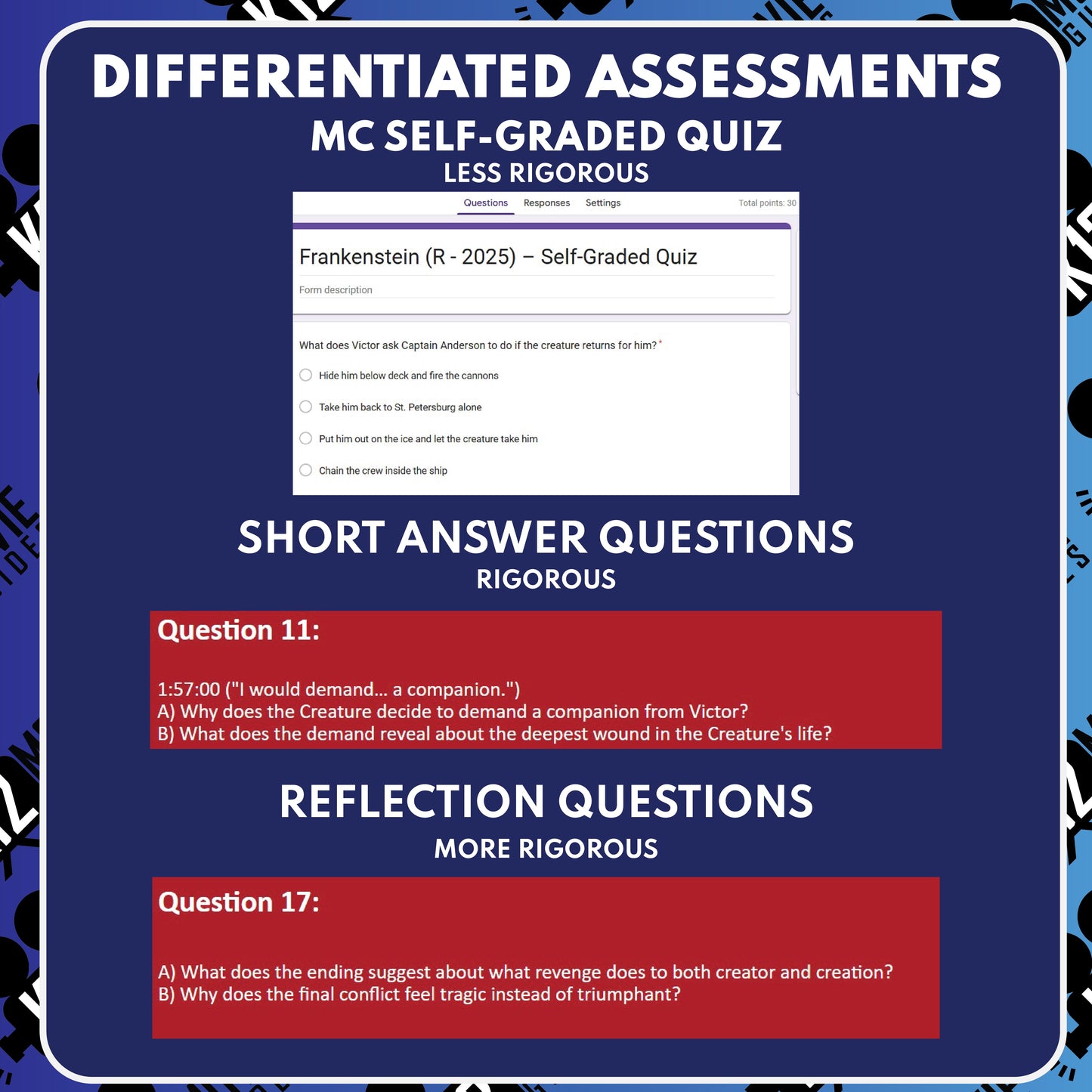
Engaging questions include scene-based, time-stamped prompts, reflection questions, and a multiple-choice quiz for easy differentiation. It works well for whole-class viewing, homework, independent analysis, literature study, or guided small-group discussion.
Check the thumbnail images for sample questions to see if this movie guide is suitable for your students.
Film Summary:
Frankenstein frames Victor Frankenstein's confession as a tragic account of ambition, grief, abandonment, and moral collapse. As Victor tries to conquer death and the Creature struggles to understand his own existence, the film asks who becomes monstrous when creation is separated from responsibility.
Parental Guidance:
Rated R for bloody violence and grisly images. See details on IMDb: https://www.imdb.com/title/tt1312221/parentalguide/
Perfect For:
- Grades 11-12 literature and gothic fiction units
- Ethics of creation and responsibility discussions
- Appearance versus humanity analysis
- Ambition, guilt, and isolation themes
- Upper-secondary film and novel-comparison work
Skills Addressed:
- Reading for evidence
- Character motivation
- Ethical reasoning
- Compare and contrast
- Theme
- Discussion and argument
- Vocabulary in context
What's Included: (a zip file with)
Student Worksheet
- Google Slides/PPTX Print Version (Toner Tip! Print 2 Slides/Page)
- Google Slides/PPTX Digital Version
- Self-Graded Multiple Choice Quiz (30 Questions | Easy Language)
- Digital Version (Google Forms)
- Print Version (can be derived from the Answer Key not Self-Graded)
Teacher's Guide & Lesson Plan
- Pre & Post Movie Discussion Questions (themes, schema-building)
- Lesson Plan Options A, B, and C (3-day, 4-day, and 5-day pacing)
- Worksheet Answer Key + CCSS Alignment
- Multiple Choice Quiz Answer Key
- CCSS Alignment + Admin Movie Request + Parent/Guardian Permission Slip (2 Pages)
(Note: All files formatted for seamless upload to your Google Drive if desired.)
Time & Tech:
Runtime: 149 minutes. Use this resource before, during, or after viewing. Print the worksheet or assign the Google Slides/PPTX digital version, and use the Google Forms multiple-choice quiz when you want a self-grading differentiation option.
DISCLAIMER: This product is an independently created worksheet and question set for classroom commentary and instruction. It is not affiliated with the film's creators or distributors, and it does not include the movie itself. Teachers should preview films for local policy fit.
Share