

FireFlash
FireFlash | Angles, Lines & Symmetry | Grade 4 Animated Math Cards
FireFlash | Angles, Lines & Symmetry | Grade 4 Animated Math Cards
Couldn't load pickup availability
Classroom Use at a Glance
Angles, Lines & Symmetry: Show geometry with points, rays and lines, then measure and compose angles, classify triangles and quadrilaterals, and identify mirror symmetry. 12 animated targets, 36 authored Review variants and 36 Mastery variants. Supplemental visual teaching and math practice, with flexible pacing; not a full Grade 4 curriculum.
- Resource type
- Animated Math Learning Cards
- Grade band
- Grades 3–5
- Time required
- Flexible — one or more sessions
- Prep level
- Low Prep — teacher-guided access setup
- Subject
- Math
- Classroom use
- Math Practice Independent Practice Small-Group Reinforcement Lesson Review Home Support
- Includes
- Animated Learn Cards Review Practice Mastery Practice
- Tech format
- Browser-Based Learning Cards
Show geometry with points, rays and lines, then measure and compose angles, classify triangles and quadrilaterals, and identify mirror symmetry.
FireFlash Grade 4 Math uses silent animated learning cards. Students move through Learn → Review → Mastery, with feedback and an opportunity to revisit missed ideas. These digital cards supplement classroom instruction.
Try FireFlash free first: Get the free Big Numbers & Place Value Grade 4 Math pack before choosing additional topics.
What Students Explore
12 animated learning targets:
- A point marks a location. Lines and rays keep going. Segments stop at their endpoints.
- Parallel lines never meet in their shared plane. Perpendicular lines cross at a right angle.
- An angle is the opening between 2 rays that meet at one vertex.
- An acute angle measures less than 90°. A right angle is 90°. An obtuse angle is between 90° and 180°. A straight angle is 180°.
- A degree is one of 360 equal parts of a full turn.
- A protractor measures an angle from its vertex and starting ray.
- To sketch an angle, start with a ray and mark the number of degrees from its zero line.
- Adjacent angles share a vertex and a side without overlapping inside.
- An unknown angle is the whole angle minus its known part.
- A right triangle has 1 right angle. An obtuse triangle has 1 obtuse angle.
- A quadrilateral has 4 sides. Its opposite sides may be parallel in matching pairs.
- A line of symmetry divides a figure into 2 matching mirror halves.
Authored question bank: 36 Review and 36 Mastery question variants. These are authoring totals, not a promise that every variant appears in one session.
How Teachers Can Use It
Project a Learn model to discuss mathematical thinking, assign independent browser practice where authorized, reinforce a recently taught topic in small groups, or revisit challenging ideas before an assessment. Pacing is flexible, and a full pack may take more than one session.
What Is In the Learning-Card Content
- Silent animated visual models and target explanations
- Review practice with feedback
- Mastery practice across the topic
Selected Standards Connections (Partial)
4.G.A.1; 4.G.A.2; 4.G.A.3; 4.MD.C.5; 4.MD.C.6; 4.MD.C.7; TX 4.6(A); TX 4.6(B); TX 4.6(C); TX 4.6(D); TX 4.7(A); TX 4.7(B); TX 4.7(C); TX 4.7(D); TX 4.7(E)
The listed standards identify supported content, not full coverage of every learning requirement or proof that the digital activity replaces teacher-led instruction.
Start with the Free Pack
Big Numbers & Place Value — free Grade 4 Math learning cards.
Technology & Assessment Notes
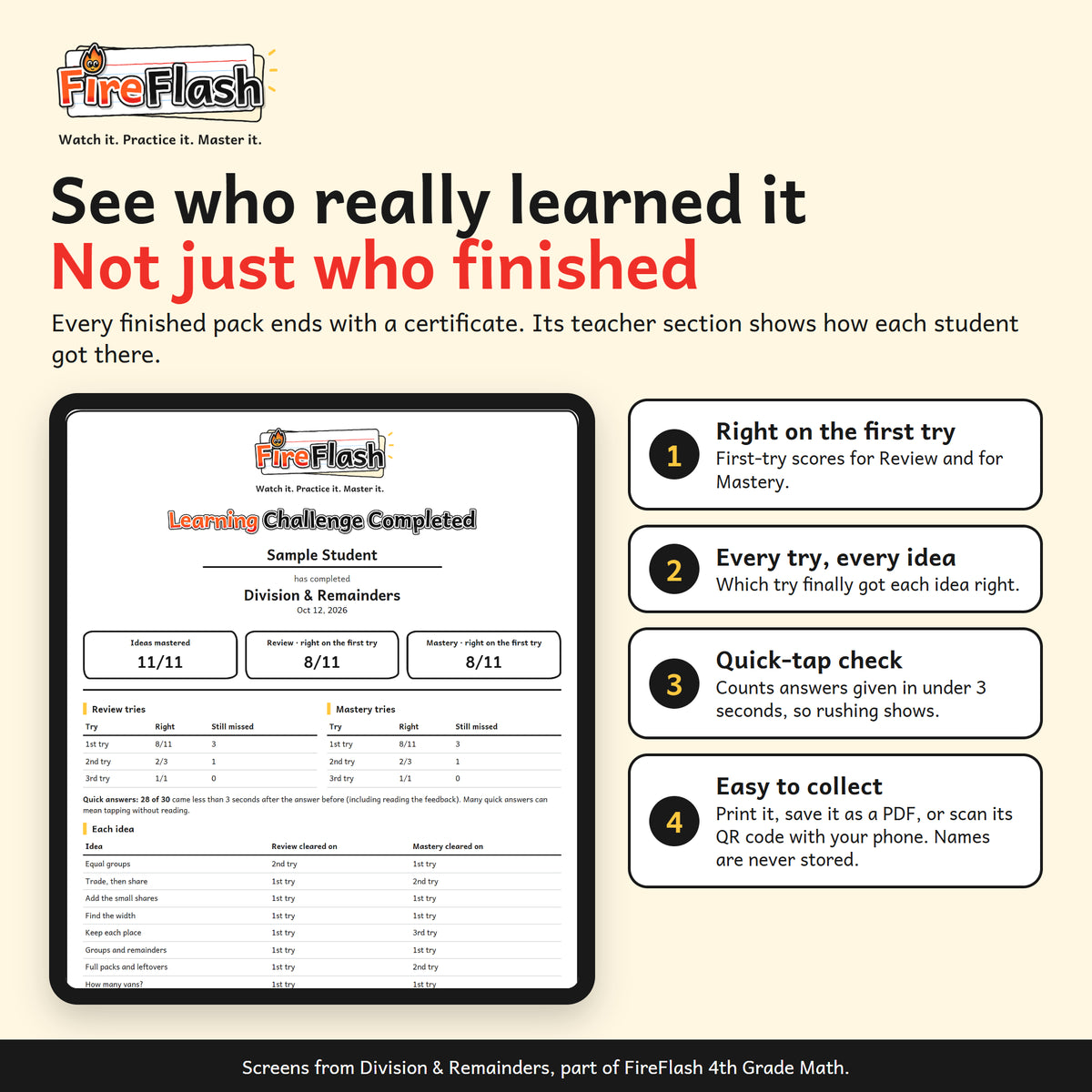
Hosted practice requires a supported browser and internet connection. Sessions store progress in the browser on that device; scores are not automatically submitted to a teacher gradebook. A qualifying completed hosted session may provide a printable snapshot showing first attempts and retries, not a permanent proficiency grade.
Share