
K12MovieGuides
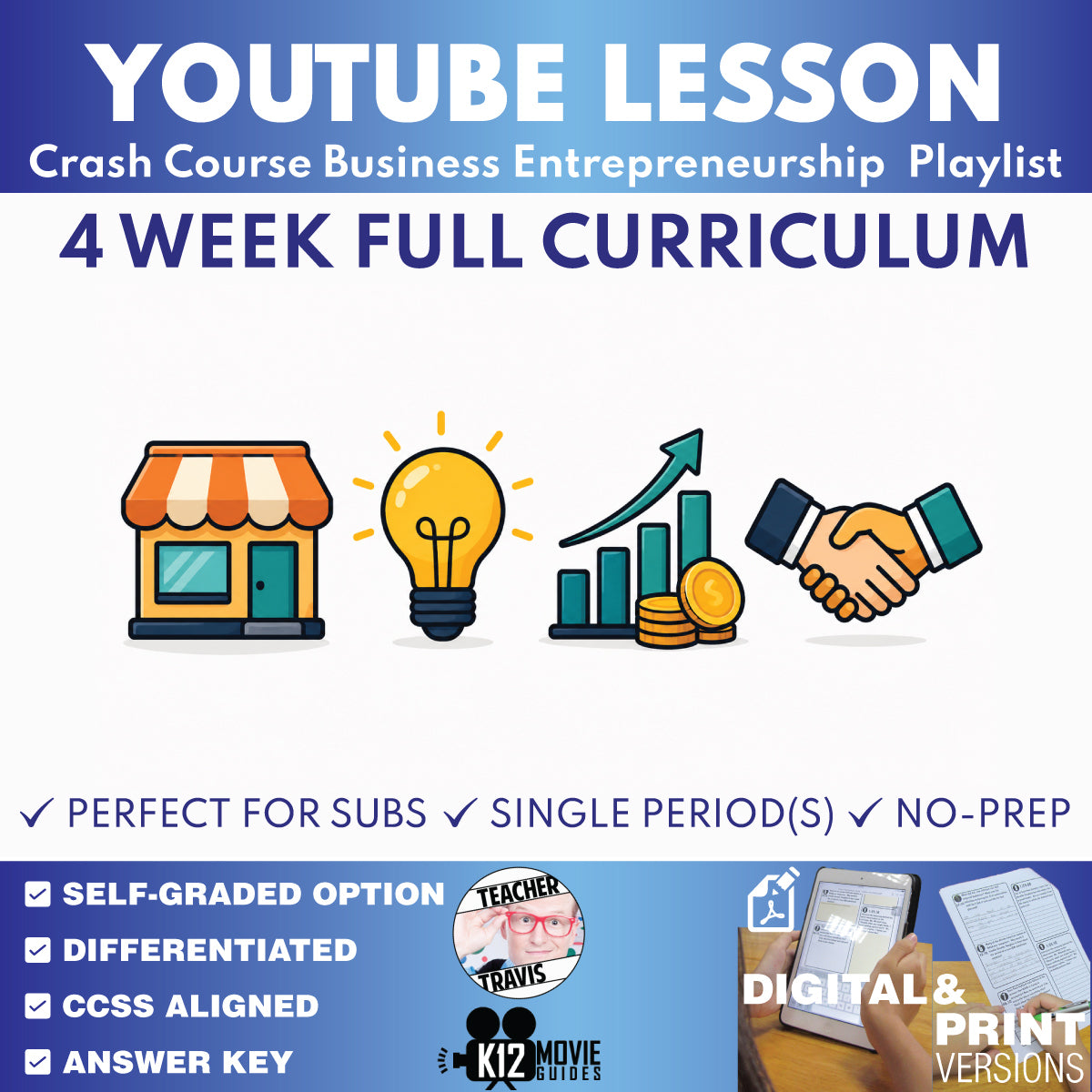
Crash Course Business: Entrepreneurship Complete Full Curriculum | 17 Episodes | 4 Weeks
Crash Course Business: Entrepreneurship Complete Full Curriculum | 17 Episodes | 4 Weeks
Couldn't load pickup availability
Classroom Use at a Glance
Complete 4-week Crash Course Business: Entrepreneurship curriculum for grades 9–12 with 17 episode lesson sets, 4 weekly assessments, 2 unit assessments, a cumulative final, Educator Planning Guide, Student Syllabus, answer keys, and print/digital classroom support.
- Resource type
- Full Curriculum Bundle
- Grade band
- Grades 9–12
- Rating
- Not Rated
- Time required
- 4-Week Curriculum; Flexible Pacing
- Prep level
- No Prep
- Subject
- Social Studies
- Classroom use
- Whole-Class Instruction Independent Work Review Flipped Classroom Curriculum Planning
- Includes
- Teacher Guides Student Worksheets Answer Keys Weekly Assessments Unit Assessments Final Assessment Educator Planning Guide Student Syllabus Google Forms Quiz Google Slides/PPTX Start Here PDF
- Tech format
- PDF Google Docs Google Slides PPTX Google Forms Google Classroom Ready ZIP File
Teach all 17 Crash Course Business: Entrepreneurship episodes as a coherent four-week, two-unit high-school entrepreneurship curriculum.
This Complete Full Curriculum combines the entire episode lesson ecosystem with four weekly assessment/review banks, two cumulative unit assessments, a cumulative Final, an Educator Planning Guide, and a Student Syllabus. The course emphasizes opportunity recognition, customer value, evidence-based business decisions, financial literacy, and strategic thinking rather than video trivia.
Try the lesson system free: FREE Crash Course Business: Entrepreneurship #1 Who Even Is An Entrepreneur?.
Preview the entire course plan free: Crash Course Business: Entrepreneurship Full Curriculum Educator Planning Guide.
New Optional Video Companion (used with YouTube)
Use the free Classroom Video Guide Companion Chrome extension with these lessons to automatically pause YouTube at question timestamps and display prompts during viewing. This optional tool can make whole-class, small-group, and independent video lessons easier to facilitate, but the resource works normally without it.
Course Architecture
- 4 weeks / 17 episodes / 2 units
- Week 1: #01-#04 Finding an Opportunity and Defining Value
- Week 2: #05-#08 Build, Test, and Organize the Business; Unit 1 boundary
- Week 3: #09-#13 Partners, Customers, Sales & Revenue; five episode days
- Week 4: #14-#17 Financial Control, Funding & Growth; cumulative Final on Day 5
- No filler/support-day lesson DOCXs required
Unit Structure
- Unit 1 | From Opportunity to a Working Business Model — Weeks 1-2 / Episodes #01-#08
- Unit 2 | Partners, Customers, Money & Growth — Weeks 3-4 / Episodes #09-#17
Assessment Architecture
- 4 weekly Assessment / Review banks (12 vocabulary, 10 A/B written-response blocks, 30 MC each)
- 2 Unit Assessments (15 vocabulary, 12 A/B written-response blocks, 40 MC each)
- 1 cumulative Final (20 vocabulary, 15 A/B written-response blocks, 60 MC)
- Assessment banks are intentionally larger than one class period so teachers can select, split, differentiate, review, or save items for retakes and make-up work
- Week 2 Day 5 prioritizes U01; W02 remains a flexible review/weekly-check bank
- Week 3 uses all five days for Episodes #09-#13; W03 remains a flexible/asynchronous or next-school-day bank
- Week 4 Day 5 is the cumulative Final; W04 and U02 remain flexible review/unit alternatives rather than three stacked full tests
Every Episode Lesson Includes
- Teacher Guide with learning targets, entrepreneurship thinking focus, misconceptions/corrections, discussion prompts, vocabulary, answer keys, standards support, and model-answer guidance
- 5 vocabulary terms
- 4 chronological time-stamped A/B questions
- 2 end-of-video A/B synthesis/application questions
- 10-question multiple-choice quiz
- Self-graded Google Forms quiz
- Digital Student Worksheet
- Print-friendly Student Worksheet
- Multiple Choice Quiz Print version
Curriculum-Level Materials
- 4 Weekly Assessment / Review Teacher Guides with companion student/quiz formats
- 2 Unit Assessment Teacher Guides with companion student/quiz formats
- Cumulative Final Assessment with companion student/quiz formats
- Educator Planning Guide
- Student Syllabus
- START HERE PDF with shared-folder access instructions
Episode Sequence
- #1 Who Even Is An Entrepreneur?
- #2 How to Develop a Business Idea
- #3 Value Proposition and Customer Segments
- #4 What Can You Learn from Your Competition?
- #5 Legal Basics and Business Entity Formation
- #6 Minimum Viable Product and Pivoting
- #7 Testing Your Product and Getting Feedback
- #8 The Core of a Business - Key Activities & Resources
- #9 How to Seek Help and Find Key Partners
- #10 How to Build Customer Relationships
- #11 How to Communicate with Customers
- #12 How to Sell Anything
- #13 Revenue Streams
- #14 Expenses & Costs - How to Spend Money Wisely
- #15 Understanding Financial Statements and Accounting
- #16 Financing Options for Small Businesses
- #17 Is Growth Right For You?
Flexible Pacing
- Standard: follow the locked 4 + 4 + 5 + 4 episode sequence and use available Day 5 periods for the highest-priority assessment checkpoint.
- Compressed: select the highest-value guided questions and use smaller subsets of the assessment banks while preserving the two-unit sequence.
- Summer / Credit Recovery: preserve the conceptual order while reducing assigned questions before removing core ideas.
- Five-episode Week 3: use W03 asynchronously, in a block period, for homework/review, or on the next available school day rather than inventing a filler day elsewhere.
Differentiation & Classroom Use
- Use vocabulary preview, sentence frames, partner talk, oral rehearsal, or selected answer-key review for additional support.
- Use digital materials for easy assignment and self-grading; use print versions for annotation, testing, or reduced screen time.
- Use selected questions for sub plans, make-up work, flipped lessons, enrichment, review, or independent study.
- Use missed assessment items diagnostically to distinguish vocabulary gaps, concept confusion, weak evidence, financial misunderstandings, or overconfident business conclusions.
Bundle Alternatives
- Crash Course Business: Entrepreneurship #1-#8 Video Lesson Set
- Crash Course Business: Entrepreneurship #9-#17 Video Lesson Set
Frequently Asked Questions
Are the Crash Course videos included?
No. This curriculum provides supplemental classroom materials designed for use with the publicly available Crash Course Business: Entrepreneurship videos.
Do I have to assign every item in the assessment banks?
No. The banks are intentionally robust so you can select the number and type of items that fit your schedule, students, and testing goals.
Why does Week 3 contain five episodes?
The five episodes on partners, customer relationships, communication, sales, and revenue form one strong instructional arc. Keeping them together preserves the content progression and leaves Week 4 Day 5 available for the cumulative Final.
Do W02, W03, W04, and U02 still exist?
Yes. They are included as flexible review, intervention, alternate-assessment, retake, homework, or asynchronous banks when the strict four-week calendar does not provide a separate full assessment day.
Can I use this with Google Classroom?
Yes. The lesson ecosystem includes digital student materials and self-graded Google Forms support, along with printable options.
Does this replace a district's complete business or entrepreneurship curriculum?
This is a structured supplemental entrepreneurship curriculum built around the Crash Course video sequence. Teachers can add local projects, market research, financial practice, simulations, and district-required standards work as appropriate.
Is this an official Crash Course product?
No. This independent educator-created curriculum is not affiliated with or endorsed by Crash Course or Complexly.
Share