
K12 Movie Guides
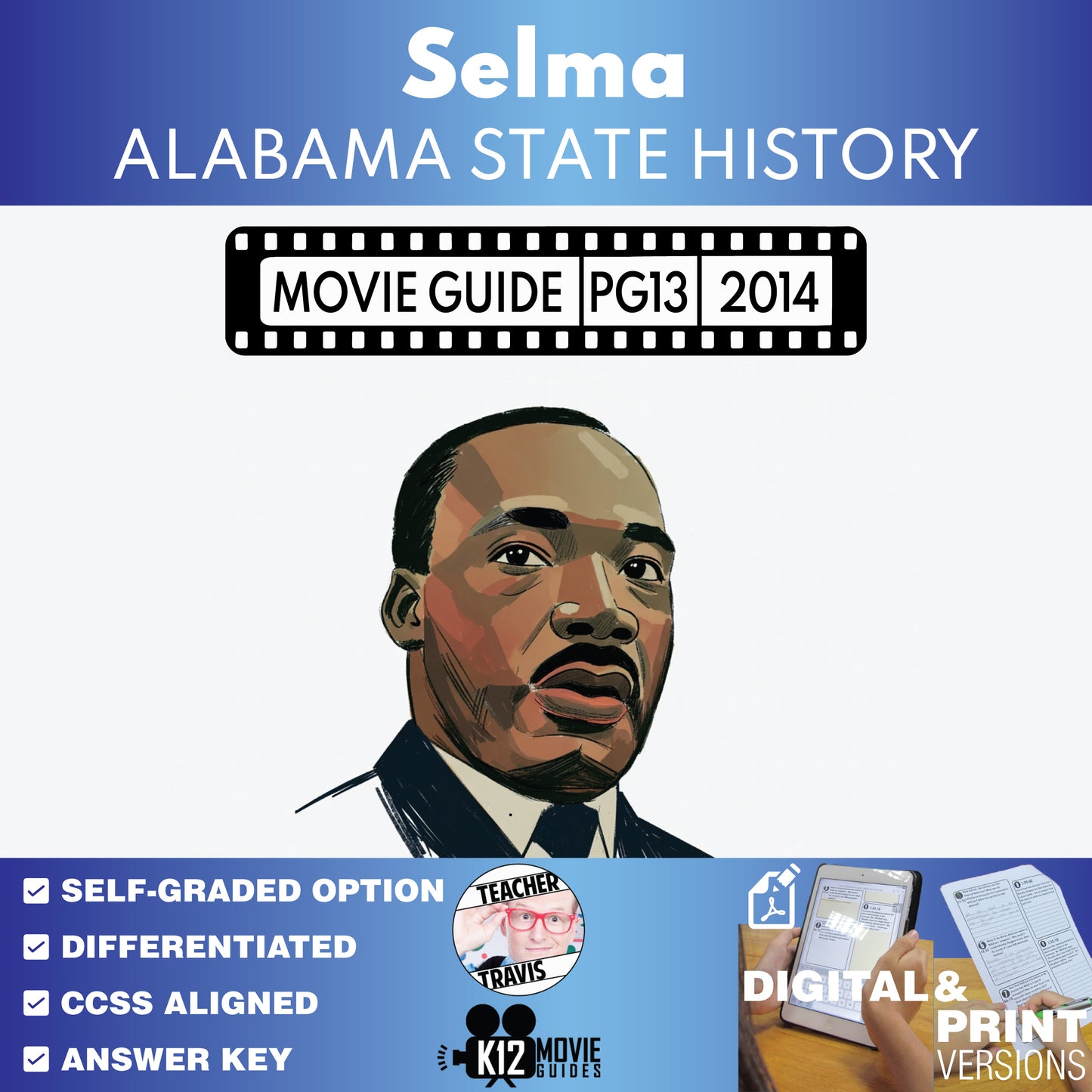
Alabama State History: Selma Film Quiz & Movie Guide Questions (PG13 - 2014)
Alabama State History: Selma Film Quiz & Movie Guide Questions (PG13 - 2014)
Couldn't load pickup availability
Classroom Use at a Glance
No-prep Selma film quiz and movie guide for Grades 9-12 alabama state history instruction with film evidence questions, discussion, and writing support.
- Resource type
- Film Quiz & Movie Guide
- Grade band
- Grades 9–12
- Rating
- PG-13
- Runtime
- 128 minutes
- Time required
- Full Film + Follow-Up
- Prep level
- No-Prep
- Subject
- Social Studies
- Classroom use
- Full Film Lesson Movie Day Accountability State History Lesson Discussion Evidence-Based Writing
- Includes
- Movie Questions Answer Key Multiple-Choice Quiz Discussion Questions Writing Prompts
- Tech format
- Printable PDF Google Slides Google Forms Quiz Google Classroom Ready
Alabama State History: Selma Film Quiz & Movie Guide Questions (PG13 - 2014)
Make Selma easier to teach with a no-prep film quiz focused on voting rights, selma, dallas county, pettus bridge, montgomery, and alabama civil rights history.
This resource helps high school students follow the film with purpose while connecting key scenes, dialogue, places, and conflicts to Alabama state history. The questions keep students grounded in film evidence instead of treating the movie as passive viewing.
Use this movie guide for Grades 9–12 history, state history, U.S. history, film study, media literacy, sub plans, or discussion-based classes.
Where is the preview? Will this lesson meet your needs?
Check out a full FREE state history movie guide example here:
West Virginia State History: Matewan Film Quiz (1987)
Classroom Use at a Glance
- Best for: Grades 9–12 U.S. History, Alabama history, civil rights, and voting rights
- Use cases: full-film lesson, sub plan, state standards review, discussion-based classes, or film study
- State focus: voting rights, Selma, Dallas County, Pettus Bridge, Montgomery, and Alabama civil rights history
- Key themes: voting rights, local power, organized protest, public courage, media attention, and federal response
- Skills addressed: cause and effect, civic rights analysis, dialogue evidence, source comparison, historical context, and evidence-based written response
- Differentiation: students can complete the written movie guide or use the 30-question multiple-choice quiz as an alternate assessment
- Time needed: movie runtime plus about 45–60 minutes for pauses, discussion, and written work
- Formats included: printable worksheet, Google Slides/PPTX, Google Forms quiz, teacher guide, answer keys, and standards alignment
Guidance & Summary
Selma (2014) is rated PG-13 and has a runtime of about 128 minutes. Teachers should preview the film and follow school policy for movie approval.
Selma follows the voting-rights campaign centered in Selma, Alabama, as local organizing, courthouse registration barriers, public protest, and federal pressure build toward the Voting Rights Act of 1965.
State-Specific Questions & Standards Focus
Focuses on AL 2024 U.S. History II Standard 12b, Alabama’s role in the modern Civil Rights Movement, including the Selma-to-Montgomery Marches and the Voting Rights Act of 1965, with supporting attention to Standard 12c on Alabama civil-rights leaders and foot soldiers.
The time-stamped questions focus on selma, dallas county voter registration, sheriff jim clark, governor george wallace, pettus bridge, montgomery, local organizing, media attention, federal response, and the voting rights act.
Why Teachers Use This Movie Guide
This guide gives students a clear structure for watching the film with purpose. Instead of passively following the plot, students track how specific scenes connect to state history, civic conflict, historical memory, and evidence-based interpretation.
The questions work well for teachers who want students to discuss voter registration barriers, county and state power, protest strategy, ordinary marchers, media attention, and federal civil-rights action using specific film evidence.
Differentiation Options
The teacher guide includes a written-response path and a multiple-choice quiz path.
- Use the written worksheet when students are ready to explain scene evidence, historical context, and state-history connections in more detail.
- Use the 30-question multiple-choice quiz when students need fewer writing demands, a faster assessment, or a more accessible review option.
- Support options include reading questions aloud, offering small-group testing, allowing extended time, or having students explain selected answers orally.
What’s Included
- Rigorous short-answer questions, chronological and time-stamped
- End-of-film reflection and challenge questions
- 30-question multiple-choice quiz for differentiation
- Teacher guide and lesson plan
- Answer keys after each written and multiple-choice question
- State standards alignment and CCSS alignment
- Pre- and post-movie discussion questions
- 3-day, 4-day, and 5-day pacing options
Flexible Lesson Pacing
- 3-Day Sprint: best for tight schedules or classes that do better with smooth viewing and discussion after the film.
- 4-Day Flexible Plan: best for teachers who want either discussion before and after the film or selected pause-and-write checkpoints during viewing.
- 5-Day Full Week: best for classes that need more guided discussion and writing time in class, with less take-home work.
Skills Addressed
- Cause and effect
- Civic rights analysis
- Historical context
- Dialogue evidence
- Source comparison
- Media literacy
- Evidence-based written response
Frequently Asked Questions
Can I use this as a sub plan?
Yes. The movie guide includes structured questions, answer keys, and flexible pacing options, so it can work as a planned film lesson or a reliable sub plan.
Does this include a digital version?
Yes. The guide includes Google Slides/PPTX materials and a Google Forms version of the multiple-choice quiz.
Is there an answer key?
Yes. The teacher guide includes answer keys after each written question and each multiple-choice question.
How long does the resource take?
Plan for the movie runtime plus about 45–60 minutes for questions, discussion, and written work.
How is this differentiated?
Students can complete the written-response movie guide or use the 30-question multiple-choice quiz as an alternate assessment with more accessible language.
Share