
K12 Movie Guides
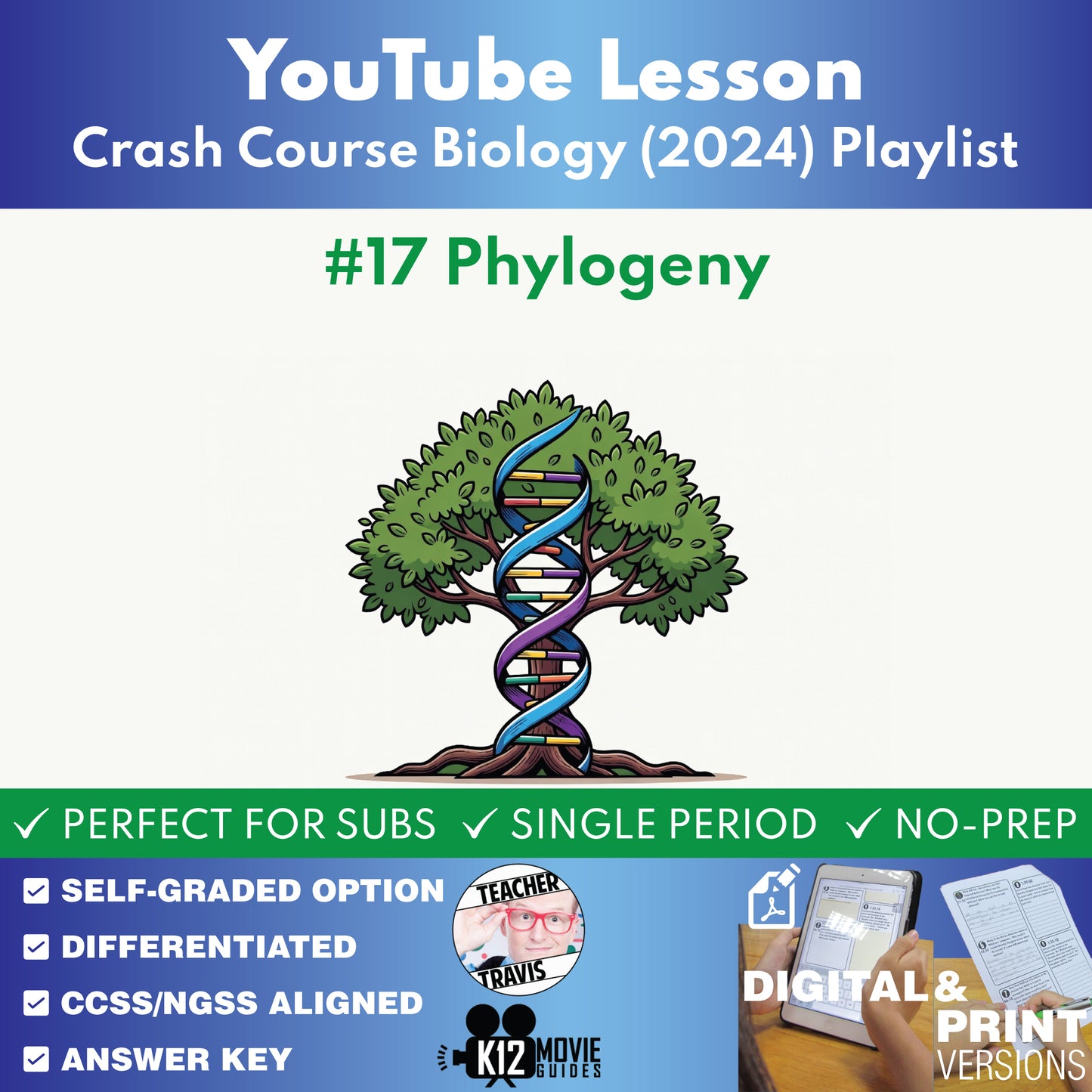
#17 Phylogeny | Crash Course Biology (2024) YouTube Video Lesson
#17 Phylogeny | Crash Course Biology (2024) YouTube Video Lesson
Couldn't load pickup availability
Classroom Use at a Glance
No-prep Crash Course Biology (2024) YouTube video lesson for Grades 8-12. Focuses on phylogeny, homologous traits, analogous traits, dna evidence, neutral theory, phylogenetic trees, nodes, sister taxa, clades, and gene flow with vocabulary, chronological questions, discussion prompts, answer key, quiz, and Google Classroom support.
- Resource type
- YouTube Video Lesson
- Grade band
- Grades 6–8 Grades 9–12
- Rating
- Not Rated
- Runtime
- 10–15 minutes
- Time required
- 20–45 minutes
- Prep level
- No-Prep
- Subject
- Science
- Classroom use
- Sub plans Guided video lesson Biology review Science literacy Google Classroom assignment Flipped lesson Absent-student makeup work
- Includes
- Teacher guide Student worksheet Answer key Vocabulary questions Time-stamped short-answer questions End-of-video questions Multiple-choice quiz Google Forms quiz Google Slides/PPTX Start Here PDF
- Tech format
- Printable PDF Google Slides PowerPoint/PPTX Google Forms Google Docs Google Classroom Ready ZIP File
Make Phylogeny easier to teach with a no-prep YouTube video lesson focused on phylogeny, homologous traits, analogous traits, DNA evidence, neutral theory, phylogenetic trees, nodes, sister taxa, clades, and gene flow.
Students learn that phylogeny is the study of branching evolutionary histories. The video explains how biologists compare anatomy and DNA, distinguish homologous and analogous traits, use neutral genetic changes, read nodes, sister taxa, and clades, and understand that gene flow can make evolutionary trees more like networks.
Use this video guide for Grades 8-12 biology, environmental science, NGSS review, science literacy, sub plans, or discussion-based classes. Use this lesson during use this lesson during a phylogeny lesson, evidence-of-evolution unit, cladogram or tree-reading practice, DNA evidence review, or biology assessment review; bell-ringer extension, flipped lesson, absent-student makeup work, or review. The questions help students move beyond memorizing terms and toward explaining biology concepts with evidence, vocabulary, and concise science writing.
Crash Course Biology playlist: Teachers and students access the public video separately on YouTube. Open the Crash Course Biology playlist here.
Try it free first: Will this lesson meet your needs? Try #1 Introduction to Biology FREE and preview the format before purchasing this lesson.
Future full bundle: This lesson is part of the planned Crash Course Biology (2024) YouTube Video Lesson Bundle - All 50 Episodes.
Guidance & Summary
- Phylogeny: Crash Course Biology #17 is a short educational YouTube lesson designed to help students build biology knowledge through clear explanations, examples, vocabulary, and evidence-based questions.
- Students learn that phylogeny is the study of branching evolutionary histories. The video explains how biologists compare anatomy and DNA, distinguish homologous and analogous traits, use neutral genetic changes, read nodes, sister taxa, and clades, and understand that gene flow can make evolutionary trees more like networks.
Differentiation Options
The teacher guide includes a written-response path and a multiple-choice quiz path.
- Use the written worksheet when students are ready to explain vocabulary, evidence, systems, cause and effect, and science concepts in more detail. Use the 10-question multiple-choice quiz when students need fewer writing demands, a faster assessment, or a more accessible review option.
- Support options include reading questions aloud, offering small-group testing, allowing extended time, previewing vocabulary, or having students explain selected answers orally.
What's Included
Student Materials
- Rigorous short-answer questions (chronological, time-stamped)
- End-of-video reflection and challenge questions
- 10-question multiple-choice quiz (Google Forms compatible)
Teacher Materials
- Teacher's guide and lesson plan
- Worksheet and MC quiz answer key
- NGSS and CCSS science literacy alignment
- Pre- and post-viewing discussion questions
- 20-minute, 30-minute, and 45-minute pacing options
Digital & Print Options
- All materials include Google Classroom and print options
Flexible Lesson Pacing
- 20-Minute Quick Clip: best for tight schedules, bell-ringers, early finisher blocks, or short sub plans
- 30-Minute Flexible Mini-Lesson: best for teachers who want the full short-answer guide while keeping the lesson compact
- 45-Minute Full Mini-Lesson: best for classes that need guided discussion, vocabulary support, and in-class writing time
- The teacher guide includes these pacing paths, plus options for written responses or the multiple-choice quiz as an alternate assessment.
Skills Addressed
- Read phylogenetic trees and relationship models
- Distinguish homologous and analogous traits
- Use DNA evidence to support evolutionary relationships
- Identify nodes, sister taxa, and clades
- Write concise phylogeny explanations
- Vocabulary in context
- Evidence-based written response
- Science literacy and academic discussion
- CCSS Anchor alignment connects vocabulary, evidence, discussion, and supported interpretation to NGSS HS-LS4-1.
Frequently Asked Questions
Can I use this as a sub plan?
Yes. The video guide includes structured questions, answer keys, flexible pacing options, and a multiple-choice quiz, so it can work as a planned science lesson or a reliable sub plan.
Does this include a digital version?
Yes. The resource includes Google Classroom-friendly materials, including digital worksheet and quiz options.
Is there an answer key?
Yes. The teacher guide includes worksheet answers and the multiple-choice quiz answer key.
How long does the resource take?
Plan for the video runtime plus about 20-45 minutes for questions, discussion, vocabulary, and written work.
How is this differentiated?
Students can complete the written-response video guide or use the 10-question multiple-choice quiz as an alternate assessment with more accessible language.
Copyright & Trademark Disclaimer: This independent, educator-created video companion is a supplemental classroom resource for discussion, comprehension, and educational analysis. It is not affiliated with, endorsed by, sponsored by, or authorized by Crash Course, Complexly, YouTube, or any related rights holders. Teachers and students access the public video separately through lawful classroom viewing methods. All trademarks and copyrights remain the property of their respective owners.
Share